
C H A P T E R
N ° 56
The Insurance Sector and Mitigation Measures
As the Sun moves through cycles of heightened activity — culminating in periods of solar maximum — severe and extreme space weather events present a unique frontier of risk. Unlike localized perils such as hurricanes or earthquakes, space weather is a global phenomenon. It ignores geopolitical borders and has the capacity to simultaneously drench, degrade, and disrupt critical infrastructure worldwide.
For the modern financial system, and specifically the insurance sector, space weather introduces a risk of a dual-front crisis. Insurers can face massive, aggregated underwriting liabilities from cascading infrastructure collapses. Simultaneously, they must protect their own increasingly digitized, cloud-dependent corporate operations from the very same celestial disruptions. Managing this risk requires an immediate, structural evolution in how the global economy models, prices, and survives solar-induced shocks.
In today’s article, we will examine how global insurance and reinsurance carriers are actively protecting their balance sheets and digital infrastructure from the systemic impacts of extreme space weather.

Image Credit: Macrovector_official / Freepik.
The insurance sector
The insurance sector serves as the global economy's primary financial safety net by assessing, pricing, and assuming risks to protect individuals, corporations, and governments from catastrophic financial loss.
At its core, the industry operates on the principle of risk pooling and diversification. Insurers collect payments (premiums) from a large pool of policyholders and use this accumulated capital to pay for the losses of the few who suffer a covered event. To protect their own balance sheets from overwhelming regional or systemic disasters, primary insurers pass a portion of their risk onto reinsurance companies — effectively acting as insurers for insurance companies.
The sector relies heavily on catastrophe modeling (cat models) and historical data to calculate defensible premiums and ensure it maintains adequate capital reserves. When new, highly correlated, or unpriceable systemic threats emerge, the industry must dynamically rewrite policy terms and exclusions to safeguard its financial solvency.
Space weather
‘Space weather’ refers to environmental conditions in space driven by the Sun’s dynamic behavior, which can directly disrupt technologies and infrastructure on and beyond Earth.
Unlike normal terrestrial weather (such as rain or wind), space weather is fueled by solar activity. The primary drivers include solar flares (bursts of intense radiation) and coronal mass ejections (CMEs), which blast billions of tons of magnetized solar plasma into space.
When these solar eruptions interact with Earth’s magnetic field and upper atmosphere, they trigger radiation- and geomagnetic storms. While they produce beautiful auroras (the Northern and Southern Lights), severe events carry the potential to cause widespread power grid failures, degrade satellite electronics, scramble navigation systems, and knock out global communication networks.
Space Weather and the Insurance Sector: The Dual-Front Threat
As the Sun moves through cycles of heightened activity—culminating in periods of solar maximum—severe and extreme space weather events present unique structural challenges to the global economy. Unlike localized natural catastrophes like hurricanes or earthquakes, space weather is a borderless phenomenon. It can simultaneously damage critical infrastructure on a global scale, causing complex cascading effects across electricity networks, satellite constellations, and digital systems.
The primary driver of terrestrial damage stems from intense solar activity that induces shifting magnetic fields. These fields create electric fields on the ground via electromagnetic induction, generating Geomagnetic Induced Currents (GICs) — electrical currents that flow on and into the Earth's surface, driving direct current (DC) into highly interconnected grids. These induced currents can collapse major electrical transformers and trigger widespread, long-duration power grid failures. Simultaneously, high-energy particle events and heightened atmospheric drag cause severe satellite disruptions, damaging both the exterior hulls and internal electronics of orbiting assets while altering their paths — drastically increasing the risk of orbital collisions. Furthermore, ionospheric anomalies scatter radio waves, disrupting Global Positioning System (GPS) signals and Satellite Communications (SATCOMS). This immediate loss of navigation and communication creates rapid, cascading disruptions across dependent critical infrastructures, such as aviation, maritime shipping, and global logistics networks.
By introducing massive accumulation risks capable of threatening multi-trillion-dollar systemic losses, space weather profoundly impacts the insurance sector. It forces insurers to aggressively rewrite policy terms, launch specialized coverage structures — such as the Insurance Services Office Space Weather Exclusion (CP 10 79 06 26) — and entirely overhaul traditional catastrophe models. The vulnerability of the modern insurance sector is split across two distinct, compounding fronts:
The Underwriting Front: Multi-Sector Claims Cascades
Beyond the insurance sector's own walls, space weather acts as a systemic risk multiplier, directly triggering complex, multi-sector insurance claim cascades that pressure underwriter capital reserves. Because a single celestial event simultaneously impacts global electrical grids, orbital infrastructure, and transport networks, a single space weather event has the potential to trigger concurrent claims across independent business lines. Standard commercial property, business interruption (BI), marine, aviation, cargo, cyber, and directors and officers (D&O) liability policies can all be exposed at once. This unprecedented aggregation of highly correlated losses threatens to breach standard insurer capital reserves, directly challenging overall market solvency.The Operational Front: Corporate Infrastructure Vulnerability
Simultaneously, the insurance sector itself is highly vulnerable from an operational standpoint. Modern carriers operate vast, data-heavy technological backbones and rely heavily on continuous multi-region data synchronizations, cloud-hosted risk algorithms, and real-time global communication. Because these internal systems and data pipelines are susceptible to solar-induced electrical and atmospheric anomalies, a severe space weather event presents a unique bottleneck: it can simultaneously cripple an insurer's global client base while paralyzing the corporate IT infrastructure needed to ingest claims, calculate ongoing exposures, and deploy capital.
Mitigation measures
Strategic Mitigation: How the Industry Protects Itself
To insulate their balance sheets and maintain operational continuity against extreme space weather, global insurance and reinsurance carriers are deploying strict legal, data-driven, and technical defenses.
Legal Defenses: Total Policy Exclusions
To protect their balance sheets from unpriceable accumulation risks, commercial property insurers are moving away from covering these events under standard "all-risk" frameworks.
The ISO space weather exclusion (CP 10 79 06 26): Effective June 2026, the Insurance Services Office (ISO) introduced a mandatory space weather endorsement. This strict policy language explicitly strips coverage for all direct and indirect losses caused by solar flares, coronal mass ejections (CMEs), geomagnetic storms, and solar energetic proton events.
Elimination of secondary fire exceptions: Crucially, this exclusion is absolute. It completely eliminates exceptions for secondary damage — such as fires triggered by electrical grid surges — which traditionally survived standard policy exclusions under "ensuing fire" doctrines.
NOAA and space agency validation: To legally enforce these exclusions during a claims dispute, insurers rely on the National Oceanic and Atmospheric Administration (NOAA) and its Space Weather Prediction Center (SWPC). The National Oceanic and Atmospheric Administration’s (NOAA) standardized space weather scales (G-scale for geomagnetic storms, S-scale for radiation, and R-scale for radio blackouts) serve as the definitive legal benchmark to verify that a loss was directly or indirectly caused by a solar event.
Catastrophe (Cat) Modeling: Tail-Risk Simulation
Because historical data on extreme space weather is sparse — with the 1859 Carrington Event serving as the only modern benchmark — underwriters cannot rely on standard actuarial tables. The industry has overhauled its models to handle severe systemic threats.
Macro-economic modeling: Syndicates like Lloyd’s of London, working alongside the Cambridge Centre for Risk Studies, model extreme space weather as a severe systemic risk. Their baseline scenarios indicate a severe solar storm could cause up to $2.4 trillion in global economic damage over a five-year recovery period.
Real-time space telemetry integration: Reinsurance giants such as Munich Re and Allianz partner directly with the European Space Agency (ESA). By integrating live satellite telemetry into natural catastrophe models, specialty underwriters simulate hundreds of thousands of never-before-seen geomagnetic storm scenarios to calculate defensible, risk-adjusted pricing for exposed lines of business.
Operational IT hardening: Safeguarding internal networks
Technology teams at major carriers are actively hardening their ground-level data centers and digital pipelines against solar-induced electrical and atmospheric anomalies.
Hardware mitigation against bit-flips: High-energy solar protons can penetrate standard computer memory, causing Single Event Upsets (SEUs), or "bit-flips," which corrupt software code and data. Major carriers utilize ECC (Error-Correcting Code) memory chips in their servers to automatically detect and correct these internal data corruptions.
Decentralization and redundancy: IT infrastructure teams are moving away from single-source data servers toward fully shielded, off-grid, and geographically decentralized data backups.
Early warning action windows: Deep-space satellites (such as NOAA's DSCOVR and the SOLAR-1 satellite, which went fully operational in June 2026) sit a million miles from Earth at the Lagrange Point 1 (L1). They detect incoming coronal mass ejections (CMEs) instantly. This provides an early warning window ranging from several hours to days, allowing insurers and their cloud hyperscale’s to safely back up systems and isolate sensitive underwriting networks before the magnetic shockwave impacts Earth's atmosphere.
Strategic Matrix: Mapping Space Weather Vulnerabilities to Industry Solutions
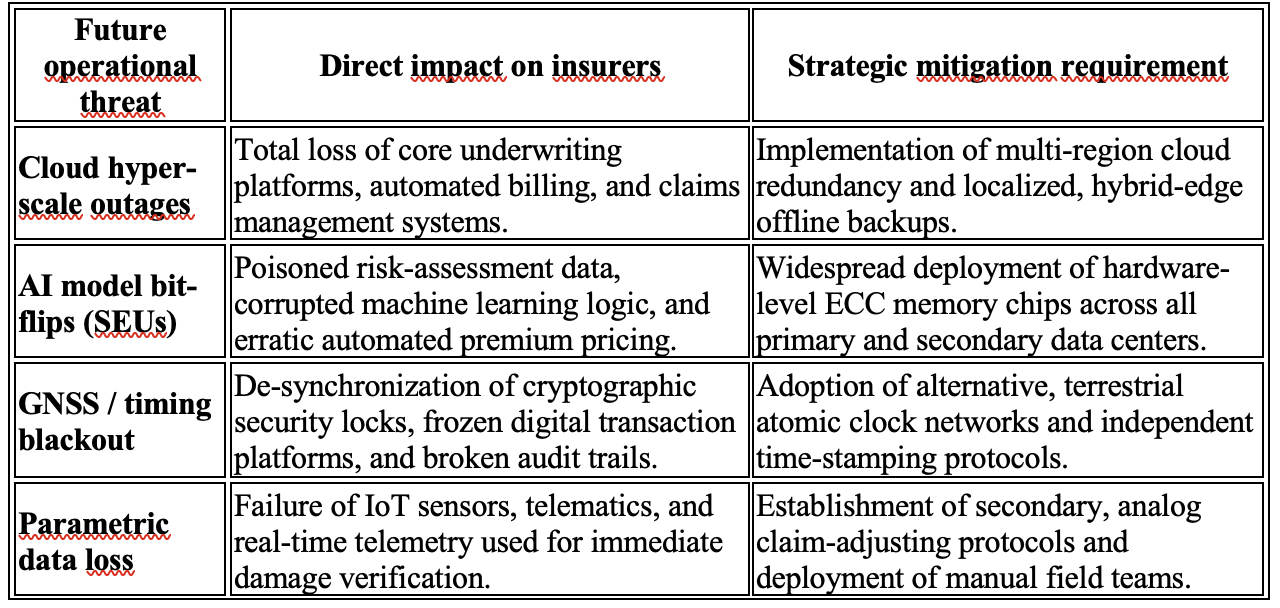
Securing the digital frontier against solar realities
The intersection of advanced digitization and space weather represents an immediate, structural challenge for the insurance industry. As carriers anchor their operations in the cloud, rely on automated underwriting, and depend on continuous orbital telemetry for claims validation, the sector's risk profile permanently changes. Space weather is no longer a peripheral concern reserved for satellite operators or aerospace engineers. Instead, it is a variable that directly dictates the daily business continuity and operational solvency of modern financial institutions.
Fortunately, the path forward does not require a retreat from technological advancement, but a proactive evolution in systemic resilience. Mitigating these risks demands a dual approach:
Technical hardening: Implementing hardware-level safeguards, such as Error-Correcting Code (ECC) memory, multi-region cloud redundancies, and analog continuity protocols to survive data and signal blackouts.
Financial innovation: Restructuring the capital architecture through dedicated space weather catastrophe bonds and mandatory operational readiness audits to ensure risks are appropriately priced and diversified.
Ultimately, space weather highlights a fundamental truth of the digital age: our most sophisticated systems are only as resilient as the infrastructure supporting them. By treating space weather as an active operational reality rather than a distant theoretical threat, the insurance sector can safeguard its infrastructure, protect its clients, and maintain stability.
Source
Allianz Commercial (2025): Understanding and mitigating the impacts of space risks. Available at: https://commercial.allianz.com/news-and-insights/reports/space-risks-2025.html
Bell, B. P. (2026): Space Weather: Insurance Coverage for Property Damage and Business Interruption Caused by Solar Storms, Miller Friel PLLC Insurance Coverage Blog, 16 April. Available at: https://millerfriel.com/insurance-coverage-for-space-weather-losses/
European Space Agency (ESA) (2025): Come rain or shine - how satellite data is helping the specialty insurance market, ESA Business Applications and Space Solutions (BASS), 20 October. Available at: https://business.esa.int/news/come-rain-or-shine-how-satellite-data-helping-specialty-insurance-market
Florida Division of Emergency Management (2026): Space Weather Operational Framework, State Risk Management Portal. Available at: https://flshmp-floridadisaster.hub.arcgis.com/pages/space-weather
Morrison, I. (2025): A newfound risk: extreme space weather?, Aspectus Group News & Insights, 8 May. Available at: https://www.aspectusgroup.com/news/a-newfound-risk-extreme-space-weather/
Shavel, L. (2025): Emerging Risks to Watch: Space Weather, Quantum Sensors, and Digital Addiction, Insurance Journal, 17 November. Available at: https://www.insurancejournal.com/magazines/mag-features/2025/11/17/847460.htm
Sivadas, N. and Walach, M. (2026): ‘Correcting solar wind measurement uncertainties reveals proportional upper atmosphere electric current response without saturation limits’, Nature, 15 July, doi: 10.1038/s41586-026-10757-4. Translated summary available at: NASA and Lancaster study finds extreme solar wind can double impact on Earth, DongA Science.
Trischan, C. L. (2026): Space Weather and Commercial Property Insurance, International Risk Management Institute (IRMI) Expert Commentary, 24 April. Available at: https://www.irmi.com/articles/expert-commentary/space-weather-and-commercial-property-insurance
