
C H A P T E R
N ° 53
The Banking Sector and Mitigation Measures
Space weather poses significant systemic risks to the financial sector through infrastructure disruption and behavioral impacts on trading. Extreme events can trigger global economic losses, with Lloyds of London estimating scenarios of up to $2.4 trillion.
The banking sector (sub-sector of the financial sector) is the foundational service industry that manages money, credit, and financial transactions for individuals, businesses, and governments within the financial sector. Its core function is to take deposits and channel these funds into loans and investments, fueling economic growth and market stability.
In today’s article, we will look closer at mitigation measures against space weather impact on the banking sector. Moreover, a summary of space weather and its effects on the banking sector from the two previous articles; C H A P T E R N ° 50 The Banking Sector (Part 1) and C H A P T E R N ° 51 The Banking Sector (Part 2), will be provided. Lastly, mitigation measures will be discussed and examples of specific continuity measures that banks can take to protect their systems will be presented.

Image Credit: Talentica Software.
Space weather
Similar to terrestrial weather occurring on Earth, the Sun has its own continuous occurrence of weather. We, therefore, see activities happening on the Sun all the time. However, sometimes these activities reach a certain level of intensity, consequently causing them to interact with the Solar System. Yet, it is the phenomena/condition created through the interaction between the Sun and the Solar System (i.e., planets, moons and their surrounding space environment) that we call ‘space weather’. It is a condition and can be defined as a natural hazard comprising a wide range of phenomena caused by solar activities (i.e., activities happening on the Sun).
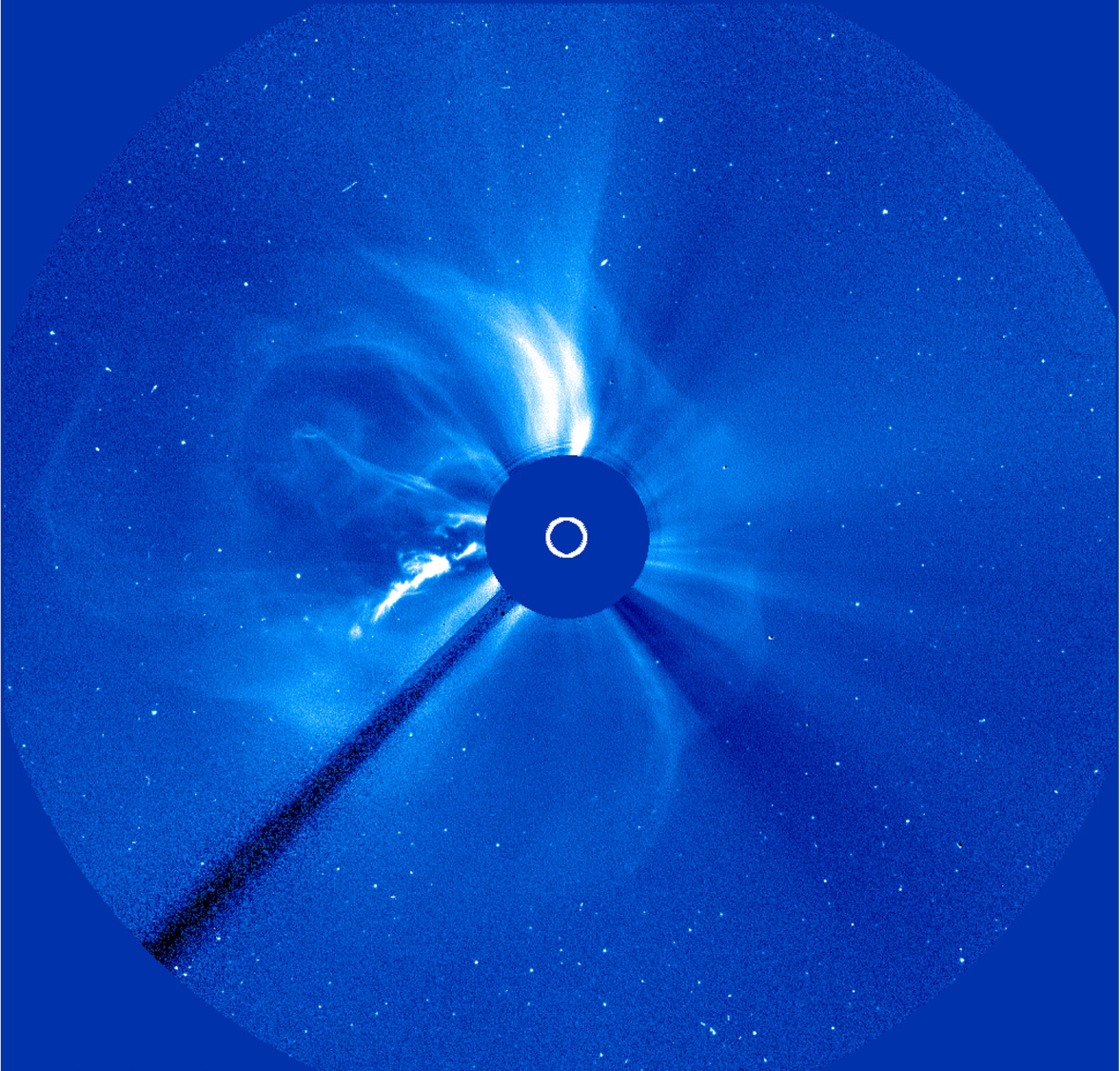
Image Credit: ESA: Solar Flare.
There are 4 types of solar activities that we focus on, when we look at the relation between space weather and critical infrastructure on Earth and within the near-Earth space environment: Solar flares, High-Speed Solar Wind Streams (HSS), Solar Energetic Particles (SEPs) and Coronal Mass Ejections (CMEs):
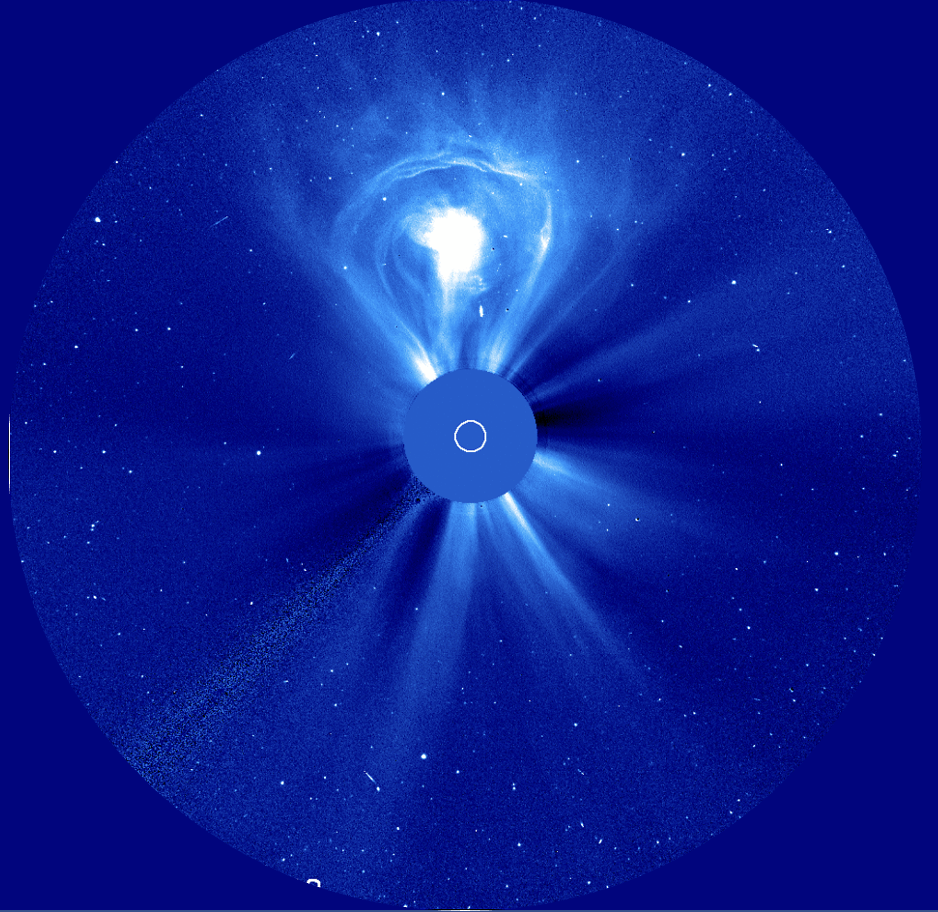
Image Credit: NASA: Coronal Mass Ejection (CME).
Solar Flares: Solar Flares are described as huge impulsive eruptions causing rapid release of plasma (UV and X-ray radiation) into the Solar System. The key impact from this type of solar activity is solar radiation storms causing radio blackouts.
High-Speed Solar Wind Streams (HSS): High-Speed Solar Wind Streams (HSS) are constant streams of plasma flowing out of regions on the Sun comprising of magnetic field that connects out to interplanetary space. The key impact from this solar activity is geomagnetic storms capable of disrupting satellites, radio signals, and power grids.
Solar Energetic Particles (SEPs): Solar Energetic Particles (SEPs) are large-scale magnetic eruptions on the Sun causing intense inflow of radiation from the Sun carried out into space. The key impact from Solar Particle Events (SPEs)is solar radiation storms creating intense increase in radiation levels, causing risks of radiation exposure to humans, and damage to space and aviation technology.
Coronal Mass Ejection (CME): Coronal Mass Ejections (CMEs) are large explosions of plasma and magnetic field from the Sun thrown into space. The key impact from this solar activity is geomagnetic storms capable of disrupting satellites, radio signals, and power grids, and causing atmospheric drag and bright auroras, among other things.
Space weather and the banking sector
The banking sector is considered a critical infrastructure as it serves as the circulatory system of the global economy. If banking services fail, everyday life, business operations, and government functions immediately shut down.
Space weather awareness is critical for the banking sector. Solar activity, like solar flares and coronal mass ejections (CMEs), releases massive clouds of charged particles into the space environment. When these clouds collide with the Earth’s magnetic field (magnetosphere), they trigger dynamic electromagnetic and geomagnetic disturbances, causing technological disruptions like power grid fluctuations and satellite malfunctions. These technologies and infrastructures are critical for the functioning of the financial sector (banking being a subsector within the financial sector).
With the rise of FinTech, Artificial Intelligence (AI), and generally digitalization of banking systems, meaning fewer physical banks, the risk and vulnerabilities of space weather impact on this critical sector increases. Space weather can threaten banks across several highly interconnected areas:
Transaction timing and network synchronization
Power grid failures
Business interruption and financial spillovers
Data security and hardware damage
Market psychology and volatility
Understanding and tracking space weather, therefore, lets the financial sector take proactive mitigating actions to ensure the resilience of their infrastructure.
Space weather mitigation for the banking sector involves protecting critical infrastructure from geomagnetic and solar radiation storms. Key strategies include – but are not limited to - continuous monitoring of space weather data, establishing redundant time-stamping systems to counter Global Navigation Satellite Systems (GNSS)/Global Positioning System (GPS) outages, hardening power grids, and transferring residual risks through, for example, specialized insurance policies.
Mitigation Measures
Here are some specific continuity measures banks can take to protect their systems:
Transaction timing and network synchronization:
The modern global financial system relies heavily on exact timestamps provided by Global Navigation Satellite Systems (GNSS)/Global Positioning System (GPS) satellites for precise time-stamping of transactions and trade processes to process billions of automated daily transactions. Because space weather anomalies can disrupt or degrade these signals, potentially causing desynchronization, settlement delays, and severe operational logjams, institutions could employ alternative timing methods. Some examples of these could be terrestrial atomic clocks or fiber-optic network timing, to maintain operational integrity during outages. By using grandmaster clocks,GlobalPositioning System (GPS) backups, and Precision Time Protocols (PTP), it stops fake records and proves exactly when a payment was made.
Power grid failures:
Solar activity in the form of Coronal Mass Ejections (CMEs) can induce Geomagnetically Induced Currents (GICs) into power grids. This can trip protective equipment and cause widespread blackouts, immediately knocking out physical branches, ATMs, and regional banking servers. However, the servers used in banking need constant power to work. Mitigation measures could, therefore, include: 1) Uninterruptible Power Supply (UPS) systems that can act like giant batteries. They supply power to servers the instant the main power fails; 2) Backup generators, likediesel generators. These can start up right after a power outage in order to run the bank for days, and; 3) Hardware redundancy. Every critical part could have a spare ready to be use. This includes internet lines and cooling fans.
Data security and hardware damage:
Radiation from solar flares can cause silent anomalies and memory corruption in critical IT hardware, while induced currents can damage large-scale electrical transformers. By using real-time data replications, the “3-2-1” rule, active-active failover, and backup systems, banks can ensure that customers’ money and data are not lost:
Real-time data replication: Data can be sent instantly to backup servers in different places.
The “3-2-1” rule: Banks can keep three copies of a customer’ data on two different types of drives, with one copy saved offsite.
Active-Active failover: If one data hub goes offline, a secondary hub can take over with zero delay.
Frequent backups: Banks can back up data every few minutes to avoid gaps in their records.
Business interruption and financial spillovers:
An extended, multi-region power and communications outage would halt normal economic activity. Banks face massive indirect losses from business interruption, supply chain halts, and a sudden spike in market volatility tied to the cascading failure of critical infrastructure. Even without direct infrastructure damage, solar activity has been shown to occasionally impact market choices through behavioral or mood-based channels, introducing statistically measurable volatility into financial indices.
Testing, monitoring, security, and business continuity planning:
Space weather action plans could be embedded into broader technology-focused business continuity planning, ensuring seamless failovers to offline or out-of-region processing if telecommunication and power networks collapse.
Disaster drills (technology and facilities hardening): Banks could regularly pull the plug on purpose to test their backup systems. Additionally, they can make systemic stress testing, as critical data centers and retail power grids require risk assessments to deploy surge protectors, backup generators, and uninterruptible power supplies (UPS) to withstand Geomagnetic Induced Currents (GICs).
Strict timestamps for security: If all cameras and access doors use exact time stamps, it could help banks trace exactly when an issue happened.
Continuous monitoring: Integrating space weather forecasting into crisis management protocols allows banks to shift to backup operations before a major space weather event occurs, preventing market cascades.
Financial protection: Mitigating financial shocks from massive systemic outages involves specialized coverage, such as ‘Business Interruption Insurance’.
Future Outlook
Space weather affects the banking sector by disrupting the foundational technologies that financial systems rely on to function. The primary vulnerabilities and impacts include: Disrupted timing and settlement; Telecommunication blackouts; Power grid failures; and Market volatility.Understanding and tracking space weather lets the financial sector take proactive mitigating actions to ensure the resilience of their infrastructure.
Having strict plans and rules will keep the data and time services running. Utilizing active backup power, real-time data copies, and exact clocks helps stop money losses, secures customers’ funds, and meets laws from groups like the U.S. Securities and Exchange Commission (SEC) or the European Securities and Markets Authority (ESMA).
There are many ways to ensure space weather resilience within the banking sector. This article is only an introduction to this topic.
Image Credit: Anne Nygård.
Source
Electromed (2026): “Importance of NTP Server Clock in Banking and Financial Institutions”. Electromed. https://www.electromed.co.in/blog/importance-of-ntp-server-clock/
Daniyal, Ahmed (2025): ” Battery Storage for Data Centers: Reliability & Efficiency”. Sunhub. https://www.sunhub.com/blog/battery-energy-storage-data-centers/?srsltid=AfmBOooPm5xv9-S5180rRIpBJtfpPm0S3MO9IQcd3o4vamGVm0eZSo7I
CEDAR (n.d.): “Staying Operational: A Banking Technology Playbook for Uncertain Times“. CEDAR. https://cedar-consulting.com/insights/staying-operational-a-banking-technology-playbook-for-uncertain-times.html
Liebl, Darla (2026): ” Disaster Recovery Planning and Testing: How to Prepare Your Bank for a Power Outage”. Results Technology. https://www.resultstechnology.com/blog/disaster-recovery-testing-preparing-for-a-power-outage/
DELTA (2015): “Uninterruptible power supplies in banking and finance sectors”. DELTA. https://www.delta-emea.com/en-gb/news/30604
Morel, Alisha (2026): “How Banks Ensure Financial Data Protection – Strategies for Effective Data Backup”. Maarco Francis. https://maarcofrancis.com/how-banks-ensure-financial-data-protection-strategies-for-effective-data-backup/
Information2 Double Information Double Value (2026): “How Do Banks Backup Data for Financial Data Protection?”. Information2 Double Information Double Value https://www.info2soft.com/blogs/how-do-banks-backup-data.html
DATABANK (2024): “Disaster Recovery Solutions For Financial Institutions”. DATABANK.https://www.databank.com/resources/blogs/disaster-recovery-solutions-for-financial-institutions/
Krivelyova, Anna et al. (2003): “Playing the field: Geomagnetic storms and international stock markets”. Working Paper. Federal Reserve Bank of Atlanta, GA. No. 2003-5a. https://www.econstor.eu/bitstream/10419/100979/1/wp2003-05a.pdf
Oughton, Edward J. et al., (2017): ” Quantifying the daily economic impact of extreme space weather due to failure in electricity transmission infrastructure”. AGU. Space Weather Journal. Vol. 15, iss. 1. Pp. 65-83. DOI: https://doi.org/10.1002/2016SW001491
Miske, Brian et al. (2025): “Banking + Space, Orbiting wealth: The convergence of banking and space”. KPMG. https://www.kpmginfo.com/web/025764%20IG%20Plus%20Space%20Ebook%20Campaign/Banking+Space4_0404.pdf
Theodoros Daglis (2020): ” The forecasting ability of solar and space weather data on NASDAQ’s finance sector price index volatility”. ScienceDirect. Journal of Research in International Business and Finance. Vol. 52. DOI: https://doi.org/10.1016/j.ribaf.2019.101147
University College London (2016): “Building space weather resilience in the finance sector”. UCL Insights: Research Briefing. University College London. https://www.ucl.ac.uk/public-policy/sites/public_policy_redesign/files/pp_insights_research_briefing_-_space_weather_jul2016.pdf
AON (n.d.): “When the Sun strikes: preparing for the business impact of geomagnetic storms”.
https://aon.co.nz/AonNZ/media/Docs/27555-Geomagnetic-Storms-Insights-Whitepaper_v6-0.pdf
Green, Lucie (2016): “How space weather poses a risk to the finance industry”. The Conversation. https://theconversation.com/how-space-weather-poses-a-risk-to-the-finance-industry-64621
Ruffle, Simon (2016): “Understanding the economic impact of space weather risks”. Strategic Risk. https://www.strategic-risk-global.com/esg-risks/understanding-the-economic-impact-of-space-weather-risks/1419210.article
Krausmann, Elisabeth et al., (2014): “ Space weather and financial systems: findings and outlook”. ResearchGate. DOI: https://doi.org/10.2788/18855
