
C H A P T E R
N ° 54
The Insurance Sector
Space weather is an emerging risk for the insurance sector, driven by heightened solar activity, critical infrastructure interdependencies, and evolving policy exclusions.
Space weather represents a distinct, systemic risk profile that requires careful integration into modern insurance underwriting and capital modeling frameworks. As society becomes increasingly reliant on interconnected technological infrastructure, the potential financial impact of space weather grows more pronounced. Severe solar events can disrupt satellite communications, precision Global Positioning System (GPS) navigation, and terrestrial power grids, creating interconnected operational challenges for businesses worldwide. For the insurance sector, this translates into a unique risk management challenge that spans multiple traditional lines, including aviation, marine cargo, business interruption, and property-casualty.
Rather than viewing space weather as an unquantifiable "black swan" event, it necessitates forward-looking insurers to begin to treat it as a manageable operational variable. Developing industry-wide awareness is a pragmatic necessity for refining risk accumulation models, updating policy wording, and ensuring adequate capital reserves.
In today’s article, we will examine the connection between space weather and the insurance sector, outlining whyproactive technical assessment is essential for long-term portfolio resilience. Moreover, we will provide a short introduction to the insurance sector and what space weather is, followed by a discussion on space weather’s direct impact on internal systems and corporate infrastructure, and underwritten sectors and claims.

Image Credit: Outlookmoney.
The insurance sector
The insurance sector is a global financial industry split into life insurance, property and casualty (P&C) insurance, and health insurance. It functions by collecting regular payments called “premiums” from customers to cover future risks and unexpected losses. Its core economic functions are:
Moves the financial burden of unexpected accidents or disaster from individuals to large financial pools.
Collects massive amounts of unused premium funds (float) and invests them heavily into global markets and public bonds.
Supports long-term economic growth by acting as a major institutional investor worldwide.
It is a vital part of financial critical infrastructure by acting as an economic risk buffer, driving systems security standards, and managing systemic threats like cyber-attacks and climate events. Its core functions in critical infrastructure are as follows:
Economic Risk Buffer: The insurance sector absorbs large-scale shocks to energy, transport, and public health networks to maintain market stability.
Security Incentives: It sets baseline cybersecurity and safety rules that companies must follow to qualify for coverage.
Data and Modeling: It applies quantitative risk models to track vulnerabilities across complex industrial systems.
Space weather
Similar to terrestrial weather occurring on Earth, the Sun has its own continuous occurrence of weather. We, therefore, see activities happening on the Sun all the time. However, sometimes these activities reach a certain level of intensity, consequently causing them to interact with the Solar System. Yet, it is the phenomena/condition created through the interaction between the Sun and the Solar System (i.e., planets, moons and their surrounding space environment) that we call ‘space weather’. It is a condition and can be defined as a natural hazard comprising a wide range of phenomena caused by solar activities (i.e., activities happening on the Sun).
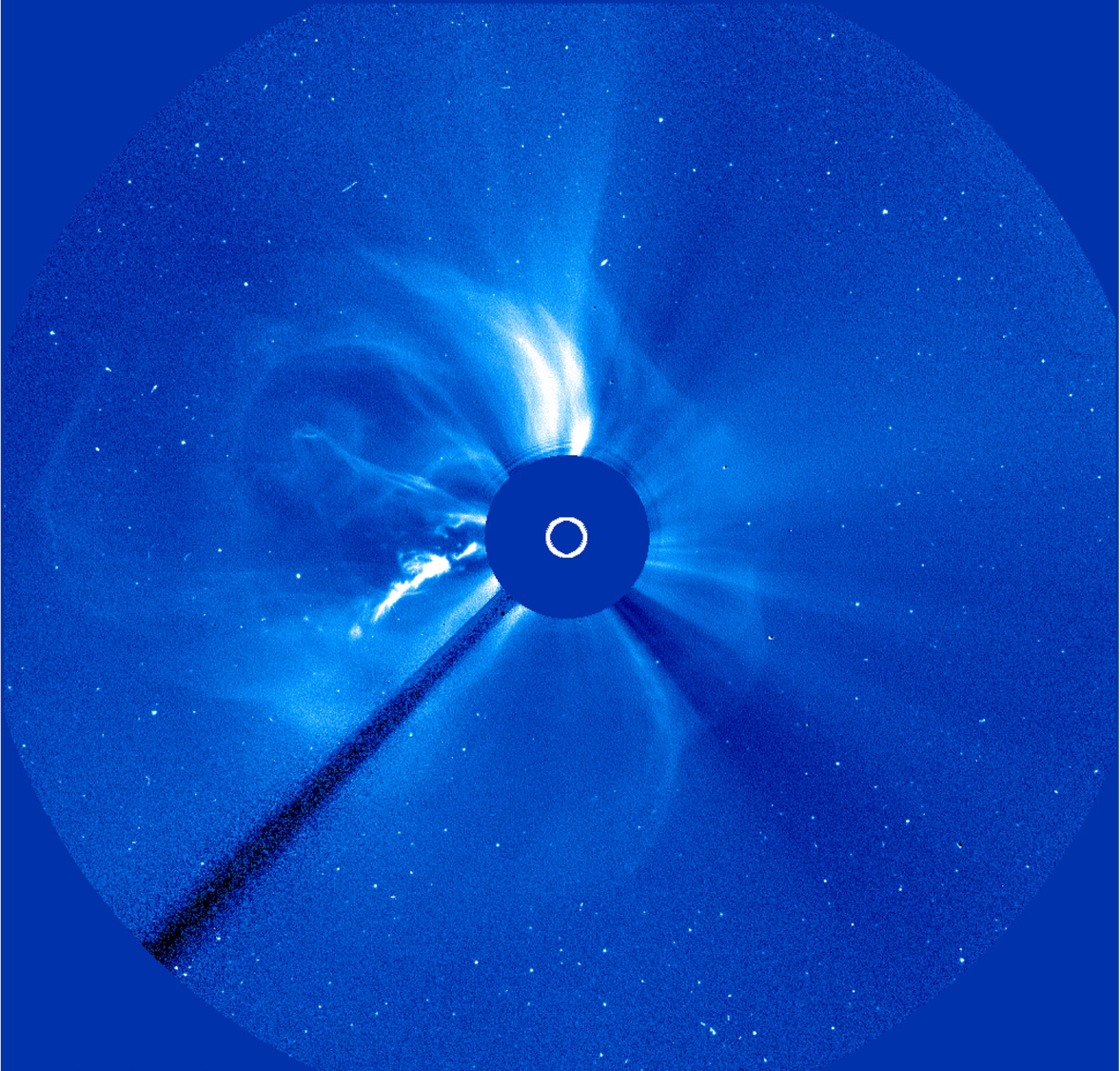
Image Credit: ESA: Solar Flare.
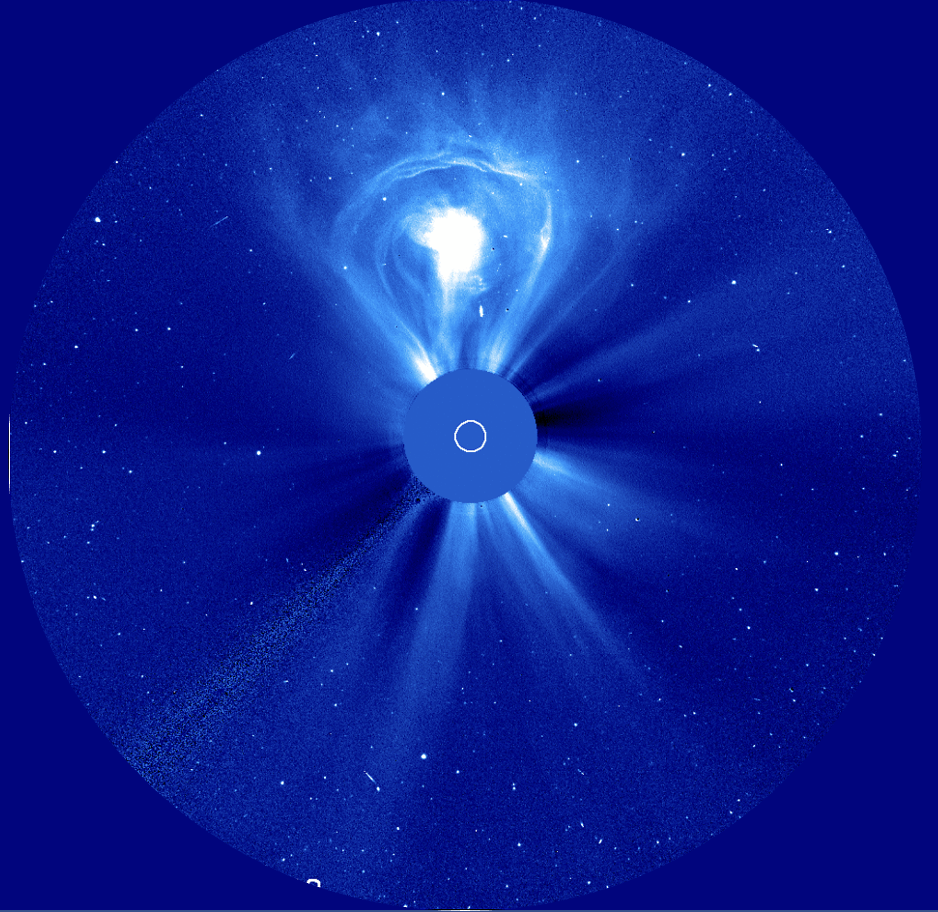
Image Credit: NASA: Coronal Mass Ejection (CME).
There are 4 types of solar activities that we focus on, when we look at the relation between space weather and critical infrastructure on Earth and within the near-Earth space environment: Solar flares, High-Speed Solar Wind Streams (HSS), Solar Energetic Particles (SEPs) and Coronal Mass Ejections (CMEs):
Solar Flares: Solar Flares are described as huge impulsive eruptions causing rapid release of plasma (UV and X-ray radiation) into the Solar System. The key impact from this type of solar activity is solar radiation storms causing radio blackouts.
High-Speed Solar Wind Streams (HSS): High-Speed Solar Wind Streams (HSS) are constant streams of plasma flowing out of regions on the Sun comprising of magnetic field that connects out to interplanetary space. The key impact from this solar activity is geomagnetic storms capable of disrupting satellites, radio signals, and power grids.
Solar Energetic Particles (SEPs): Solar Energetic Particles (SEPs) are large-scale magnetic eruptions on the Sun causing intense inflow of radiation from the Sun carried out into space. The key impact from Solar Particle Events (SPEs)is solar radiation storms creating intense increase in radiation levels, causing risks of radiation exposure to humans, and damage to space and aviation technology.
Coronal Mass Ejection (CME): Coronal Mass Ejections (CMEs) are large explosions of plasma and magnetic field from the Sun thrown into space. The key impact from this solar activity is geomagnetic storms capable of disrupting satellites, radio signals, and power grids, and causing atmospheric drag and bright auroras, among other things.
Space weather and the insurance sector
As the Sun moves through cycles of heightened activity (i.e., solar maximum), severe space weather events present unique challenges. Unlike localized hurricanes or earthquakes, severe geomagnetic storms can simultaneously damage critical infrastructure globally, causing complex cascading effects across electricity networks and digital systems.
Key critical infrastructure most-at-risk with high risk of causing complex cascading effects are:
Power grid failures: Geomagnetic Induces Currents (GICs) can collapse major electrical transformers and trigger widespread blackouts.
Satellite disruptions: High-energy particle events and atmospheric drag can damage the exterior and interior (i.e., onboard electronics) of satellites and alter their orbital path, increasing the risk of satellite-to-satellite or satellite-to-space debris collisions.
Navigation and communication: Space weather can disrupt satellite signals, disrupting services – for example - provided by the Global Positioning System Satellites and Satellite Communications (SATCOMS). A disruption to these creates cascading effects into critical infrastructure such as: aviation, maritime shipping, and logistics networks.
Space weather impacts the insurance sector by introducing massive accumulated risks that threaten multi-trillion-dollar systemic losses. This forces insurers to aggressively rewrite policy terms, launch specialized coverage options (e.g., Insurance Services Office Space Weather Exclusion (CP 10 79 06 26)), and rewrite catastrophe models. However, the insurance sector itself likewise gets affected by space weather. This is done across two distinct fronts: 1) The data claims and financial products they underwrite, and 2) The internal IT systems, data pipelines, and core infrastructure they use to run their businesses. The modern insurance sector relies heavily on continuous data synchronizations, cloud-hosted risks algorithms, and real-time communication. Due to this, a severe space weather event could simultaneously disrupt both their clients’ operations and their own corporate backbone.
Direct impact on internal systems and corporate infrastructure
Insurance companies operate vast, data-heavy technological backbones that are highly vulnerable to solar-induced electrical and atmospheric anomalies.
Data center and server corruption:
High-energy solar proton events can penetrate the Earth’s magnetic field (i.e., magnetosphere) and cause Single-Event Upsets (SEUs) in data center hardware. This directly translates to flipped bits in server memory, corrupted claim history databases, and sudden, unexplainable crashes of cloud-hosted proprietary risk-pricing models.
“A high-energy solar proton event, also called a solar proton event (SPE) or solar radiation storm, happens when the Sun ejects massive numbers of protons. These particles are accelerated to extreme speeds by powerful solar flares or shock waves from coronal mass ejections (CMEs). “
Loss of synchronized financial timing:
Global insurance and reinsurance markets rely on the Global Positioning System/Global Navigation Satellite System atomic clocks to time-stamps multi-million-dollar financial transactions, automated algorithmic underwriting, and claims processing. However, ionospheric scintillation caused by solar flares blinds these signals, threatening to disrupt or freeze the synchronized trading platforms utilized by carriers.
“ Ionospheric scintillation is the rapid fluctuation in the amplitude, phase, and polarization of radio waves as they pass through uneven patches of electrons in the Earth's upper atmosphere. It acts like the twinkling of a star, but for satellite communication signals instead of visible light. ”
Disruption of geospatial and Earth Observation (EO) data pipelines:
Modern catastrophe underwriters use real-time satellite imagery to immediately assess property damage after a disaster caused by natural hazards (i.e., hurricanes, floods etc.). However, increased atmospheric drag from solar activity can shift satellite orbits, while solar radio bursts can jam communication downlinks, consequently completely cutting off insurers from their vital post-disaster data feeds.
Internal operational downtime:
Solar activity causing severe geomagnetic storms can induce ground currents (i.e., Geomagnetically Induced Currents (GICs)) that can damage high-voltage transformers, causing momentarily or complete power grid blackouts. An event like this would make insurance carriers experience immediate office and localized data center power outages. This would force a reliance on backup diesel generators – which are vulnerable to secondary grid surges –, and cripples their customer service, claims intake, and digital portal availability.
Direct impact on underwritten sectors and claims
Beyond the insurance sectors own walls, space weather directly trigger complex, multi-sector insurance claim cascades that pressure underwriter capital reserves.
Power grid and commercial property claims:
Geomagnetically Induced Currents (GICs) enter the power grid through long transmission lines, causing large-scale voltage collapse and overheating massive transformers. For insurers, this results in staggering machinery breakdown claims, food/pharmaceutical spoilage claims, and extensive Business Interruption (BI) losses.
Aviation and maritime logistics claims:
Space weather can force commercial airlines to reroute flights away from the polar regions in order to prevent radio blackouts and to protect crews from heightened radiation exposure. When the services provided by – for example - the Global Positioning System (GPS) / the Global Navigation Satellite Systems (GNSS) gets disrupted by solar activity, causing vessels to face shipping bottlenecks or reroute deviations, the insurers face claims for massive fuel surcharges, cargo delays, and marine hull liabilities.
Satellite hard assets and launch claims:
Space weather can degrade solar panels, blinds optical sensors, and accelerates orbital decay for Low-Earth Orbit (LEO) satellites. This creates high-severity losses in the niche space insurance market, forcing carriers to heavily adjust premium rates for orbital assets.
Summary table providing a full overview of space weather impact on the insurance sector
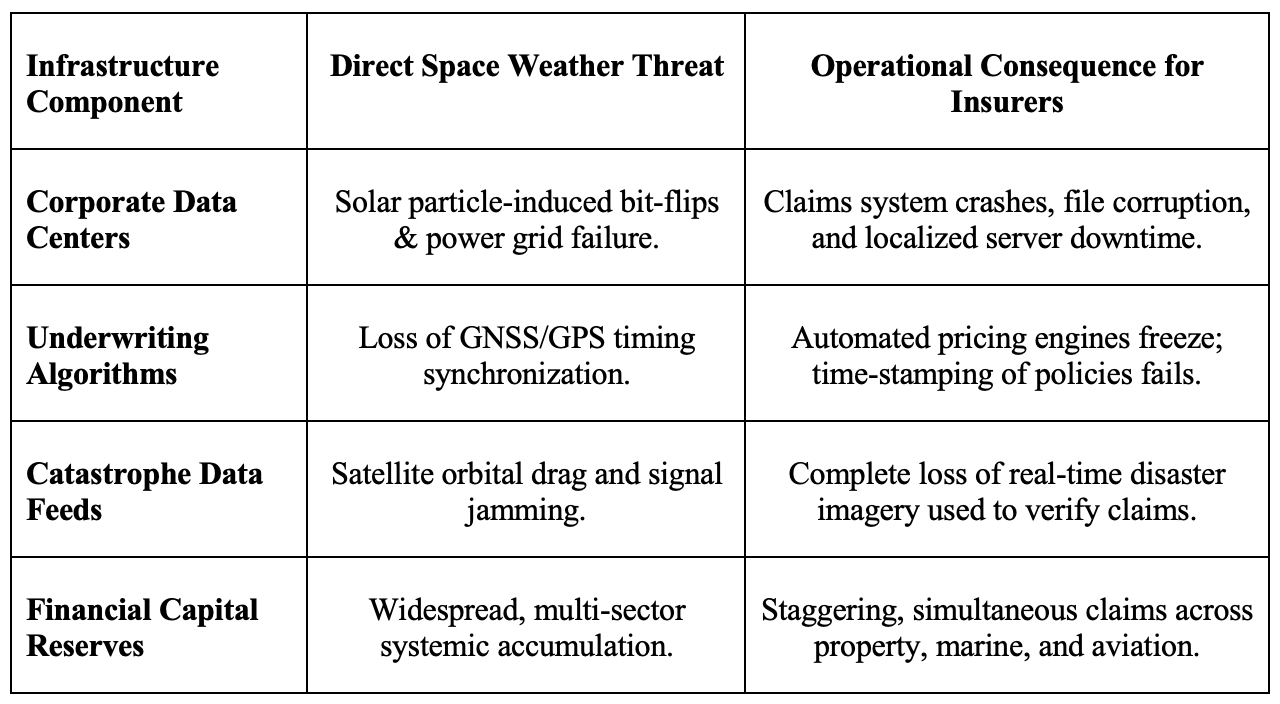
Image Credit: Hoplon (Hoplon Space)
Source
NOAA (US) (n.d.): https://www.swpc.noaa.gov/phenomena
Met Office (UK) (n.d.): https://www.metoffice.gov.uk/weather/learn-about/space-weather/what-is-space-weather
World Meteorological Organization (WMO) (n.d.): “Space Weather”. https://community.wmo.int/site/knowledge-hub/programmes-and-initiatives/wmo-space-programme-wsp/space-weather
World Bank (2021): “Financial Protection of Critical Infrastructure Services”. World Bank. License: CC BY 3.0 IGO.http://hdl.handle.net/10986/36902
Alianz SE (2026): “Allianz Global Insurance Report 2026: The Future of Insurance in a Fragmenting World”. Alianz. https://www.allianz.com/en/economic_research/insights/publications/specials_fmo/260528-global-insurance-report.html
Mapfre Economics (2025): ”Climate change: extraordinary risks and public policies”. Mapfre Economics report. https://www.economiayseguromapfre.com/number-15/climate-change-extraordinary-risks-and-public-policies/?lang=en
Evans, Steve (2025): “Cat bonds, physical risk insurance a top climate adaptation investment theme: Morgan Stanley”. ARTEMIS. https://www.artemis.bm/news/cat-bonds-physical-risk-insurance-a-top-climate-adaptation-investment-theme-morgan-stanley/
Cambridge Centre for Risk Studies (2016): “Helios solar storm scenario”. University of Cambridge Judge Business School. Cambridge Risk Framework. Technology Catastrophe Stress Test Scenario. https://www.jbs.cam.ac.uk/wp-content/uploads/2020/08/aig-helios-solar-storm-16-june.pdf
Swinhoe, Dan (2024): “Paying the premium: Why 2023 was a bad year for space insurance”. Sdx Central. https://www.sdxcentral.com/analysis/paying-the-premium-why-2023-was-a-bad-year-for-space-insurance/
Monroy, Mauricio (n.d.): Life insurance in 2050 – What risks will humanity face in the next 30 years?”. Equisoft. https://www.equisoft.com/insights/insurance/life-insurance-in-2050-what-risks-will-humanity-face-in-the-next-30-years
Schrijver, Carolus J. (2015): “Understanding space weather to shield society: A global road map for 2015–2025 commissioned by COSPAR and ILWS”. ScienceDirect. Journal for Advances in Space Research. Vol. 55, Iss. 12. Pp. 2745-2807. DOI: https://doi.org/10.1016/j.asr.2015.03.023
Market.us (2026): “Space Weather Insurance Market”. Market.us. https://market.us/report/space-weather-insurance-market/
LLOYD’S (2025): “Lloyd’s highlights risk of extreme space weather as latest scenario reveals potential global economic loss of $2.4trn”. LLOYD’S. https://www.lloyds.com/insights/media-centre/press-releases/extreme-space-weather-scenario
MILLER FRIEL PLLC (n.d.): ”Insurance Coverage for Space Weather Losses”. https://millerfriel.com/insurance-coverage-for-space-weather-losses/
Trischan, Catherine L. (2026): “Space Weather and Commercial Property Insurance”. IRMI. https://www.irmi.com/articles/expert-commentary/space-weather-and-commercial-property-insurance
