
C H A P T E R
N ° 36
Maritime Ports (Part 1)
Today’s article will be the first of three articles focused on the relation between space weather and maritime ports.
Combined, the three articles will explore maritime ports as a critical infrastructure (CI), the “system of systems” design, and the anticipated ‘megadisaster’-scenario. Additionally, they will look closer at the connection between seaports and the energy sector and space infrastructure. Moreover, they will discuss the notion of cascading risks, focused on the combination of space weather, the ‘system of systems’ design, and maritime ports. Lastly, they will consider how space weather resilience can plays a significant role within maritime resilience.
In this article; C H A P T E R N ° 36 Maritime Ports (Part 1), we will start by looking closer at the following topics: Critical Infrastructure (CI) defined, maritime as a Critical Infrastructure (CI), and the energy sector.
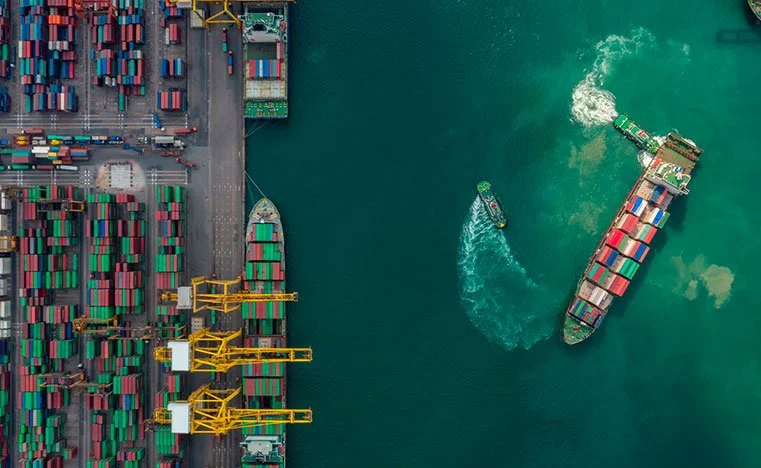
Image Credit: Conception Etude Realisation Logistique.
Critical Infrastructure (CI)
Critical infrastructure is the umbrella term for the collection of physical and virtual assets, systems, and networks that are so vital to a country's society and economy that their disruption would have a debilitating effect on national security, public health, and safety. Critical infrastructure (CI) includes terrestrial (ground-based) and space infrastructure. These are categorised as ‘Critical terrestrial Infrastructures’ and ‘Critical Space Infrastructures’ and are vital in order for a society to function properly. As critical infrastructures (CI) get increasingly more dependent on technology, it increases our modern societies vulnerability to space weather impact.
Critical terrestrial Infrastructures are ground based infrastructures and includes sectors such as the energy sector, the rail and road transport sector, and the marine sector. However, the first sign of impact of space weather on terrestrial infrastructure is found within critical space infrastructures. When discussing the impact of space weather, we, therefore, often talk about this category of critical infrastructure first.
When we use the term ‘space infrastructures’ without classifying it as ‘critical’, what we refer to are the facilities, equipment and technology that support space activities. This can be things such as satellites, rockets, ground-based space technologies, and the International Space Station (ISS). However, what is referred to when using the term ‘Critical Space Infrastructures’, is the necessary infrastructures in space that are vital in order for infrastructures on Earth to function efficiently.
Maritime ports as a Critical Infrastructure (CI)
The maritime sector facilitates over 80% of global trade and is critical to the social and economic stability of nations. The maritime supply network consists of the key components of ports and shipping operators that interlink the hinterland networks, such as road and rail networks which transport goods to inland logistics hubs. The primary function of a seaport is to facilitate the transfer of cargo from maritime vessels onwards into the transport chain (road, rail, or other vessels). Additionally, seaports serve as a location for industry and logistics activities. A seaport is, thus, used for anything from loading and unloading goods, storage, receipt and delivery, and activities of business linked to transport. Due to their significant role within the supply chain, maritime ports are considered a critical infrastructure (CI).
Critical infrastructure (CI) does not operate in isolated sectors but are characterized by a complex “system of systems” design, wherein the operation of one sector depends heavily on the functionality of one or more other sectors. This interdependency within critical infrastructure (CI) increases the possibility of cascading effects. The interconnection of systems and its relation to socio-economic systems, and the challenges of maintaining them, has made critical infrastructure (CI) failure one of the great ‘megadisasters’ inevitable to happen, unless proper mitigation strategies and procedures are created and implemented.
As a critical infrastructure (CI), the maritime sector is no different to any other critical infrastructure (CI) when it comes to a foundation build on a dependency on other sectors and industries. Maritime ports alone depend on multiple types of technologies, most of which are advanced. These advanced technologies rely on and are enabled by critical terrestrial infrastructures such as the energy sector, and critical space infrastructure like satellites.
The energy sector
Power outages disrupt maritime ports by causing significant commercial, safety, and logistical challenges, as modern port operations heavily rely on complex electrical and digital systems. Ports rely on electricity for functions like cranes, container handling systems, and IT-infrastructure, making a loss of power halt operations. Outages can, additionally, lead to safety hazards and security vulnerabilities, requiring immediate and coordinated responses to prevent accidents and ensure security. Furthermore, the inability to load, unload, or process cargo can cause significant financial losses and disrupt supply chains.
The challenges of a power outage within maritime ports do not end there. They can also cause vessel and cargo tracking issues, potential vessel collisions in busy waterways, and damage to refrigerated containers.Modern ports efficiency is, thus, significantly linked to the energy sector through digital systems, making them particularly vulnerable to blackouts, which can affect everything from vessel traffic to cargo tracking.
To be continued…
Source
Fiori, Robyn (2022): “Development of space weather services to inform maritime users of space weather events affecting high frequency radio communication”. 44th COSPAR Scientific Assembly. Held 16-24 July, 2022. Volume 44. Online at https://www.cosparathens2022.org/. Abstract PSW.1-0001-22. Pp. 3435.
Grant, Alan et al. (2012): “The effect of space weather on maritime aids-to-navigation service provision”. Annual of Navigation. Vol. 19(1). DOI: https://doi.org/10.2478/v10367-012-0005-9?urlappend=%3Futm_source%3Dresearchgate
Xue Dabin et al. (2024): “Space weather effects on transportation systems: A review of current understanding and future outlook”. Advancing Earth and Space Science (AGU). Volume 22, Issue 12. DOI: https://doi.org/10.1029/2024SW004055
Geerlings, H. et al. (2018). Introduction. In: Geerlings, H., Kuipers, B. and Zuidwijkm R. (eds.) Ports and Networks: Strategies, Operations and Perspectives. Routledge: Oxford.
OECD (2008): “Protection of Critical Infrastructure and the Role of Investment Policies Relating to National Security”.
Schlegelmilch, J. (2020): “Rethinking Readiness: A Brief Guide to Twenty-First Century Megadisasters”. New York: Columbia University Press.
Parkinson, B. W. et al. (2021): “Introduction, Early History and Assuring PNT (PTA)”. In: Morton, Y. J., Van Digglen, F., Spilker Jr, J. J. and Parkinson, B. W. (eds.) Position, Navigation, and Timing Technologies in the 21st Century: Integrated Satellite Navigation, Sensor Systems, and Civil Applications (Volume 1). IEEE Press: New Jersey
Yang, Y. et al. (2018): “Internet of Things for Smart Ports: Technologies and Challenges”. IEEE Instrumentation and Measurement Magazine, February.
Jayavardhana, G. et al. (2013): “Internet of things (IoT): a vision, architectural elements, and future directions”. Elsevier Future Generation Computer Systems, 29 (7), pp. 1645-1660.
Ishii, Mamoru et al. (2024): “Space weather impact on radio communication and navigation”. ELSEVIER. Advances in Space Research. DOI: https://doi.org/10.1016/j.asr.2024.01.043
NOAA (n.d.): “HF Radio communication”. https://www.swpc.noaa.gov/impacts/hf-radio-communications#:~:text=Space%20weather%20can%20impact%20HF%20radio%20communication,enhanced%20D%2Dlayer%20that%20blocks%20HF%20radio%20communication.
Danish Maritime Authority (n.d.): “AIS data”. https://www.dma.dk/safety-at-sea/navigational-information/ais-data
Hansen, Nicholas (2023): “Situational Awareness for autonomous marine vessels”. Technical University of Denmark (DTU). https://backend.orbit.dtu.dk/ws/portalfiles/portal/338331238/PhD_thesis_260_sider_-_76_farvede.pdf
WindWard (n.d.): “Automatic Identification Systems (AIS)”. https://windward.ai/glossary/what-is-automatic-identification-systems-ais/
SKYFI (n.d.): “Vessel tracking: keeping ships on course with moderns technology”. https://skyfi.com/en/blog/vessel-tracking-keeping-ships
Maritime Fairtrade (2024): “Navigating safety: importance of martine vessel tracking systems”. https://maritimefairtrade.org/navigating-safety-importance-of-marine-vessel-tracking-systems/
Maljković, Mislav et al. (2022): ”Situational Awareness from the master point of view and importance of factors that influence it”. ResearchGate. Conference ICTS 2022. https://www.researchgate.net/publication/361735423_SITUATIONAL_AWARENES_FROM_THE_MASTER_POINT_OF_VIEW_AND_IMPORTANCE_OF_FACTORS_THAT_INFLUENCE_IT
