
C H A P T E R
N ° 42
Autonomous Maritime Vessels (Part 1)
In recent years, the interest for fully autonomous maritime vessels have increased. The sector is investing in automation to address critical operational, safety, and environmental challenges, aiming to transform shipping into a more efficient, sustainable, and safer industry. Moreover, automation technologies like Artificial Intelligence (AI), Internet of Things (IoT), and robotics are being implemented to optimize everything from vessel navigation to port cargo handling due to the need to manage rising global trade volumes. However, the understanding of weather interferences from space on autonomous technology is still sparse.
The maritime sector is considered a critical infrastructure because it is the backbone of global trade, carrying over approximately 80% of international goods, and is essential for energy, food, and communication security. It includes vital and vulnerable assets such as ports, shipping lanes, and undersea cables, making its protection essential for national security, economic stability, and defense. Yet, critical infrastructure is characterized by a complex “system of systems” design, wherein the operation of one sector depends heavily on the functionality of one or more other sectors, consequently creating a complex and highly vulnerable net of infrastructure. The maritime sector exemplifies this interdependence clearly.
Space weather resilience is critical for the maritime sector, as modern shipping is heavily reliant on satellite-based technology, making it vulnerable to solar events. As shipping embraces "e-navigation" and autonomous vessels, the ability to withstand disruptions to – for example - Global Navigation Satellite Systems (GNSS) is essential for safety and operational continuity. Space weather resilience is a crucial element of modern maritime risk management, ensuring that ships can continue to operate safely, efficiently, and with minimal interruption during periods of intense solar activity.
“ E-navigation is the International Maritime Organization’s (IMO) strategy to harmonize, collect, exchange, and analyze maritime information on board and ashore through electronic means. It aims to enhance safety, security, and environmental protection by digitizing maritime services, reducing administrative burdens, and improving situational awareness for mariners. “
In today’s article, we will, therefore, look closer at the relation between space weather and autonomous maritime vessels. This article will be the first of two articles focused on the relation between space weather and automation in the maritime sector. Combined the articles will explore the concept of autonomous maritime vessels and the different classification degrees. Additionally, they will examine how space weather impacts the technology onboard autonomous maritime vessels, and subsequently consider the potential consequences these effects may have on both safety and overall operational efficiency at sea.
In this article, we will start by looking closer at the concept of autonomous maritime vessels, the different classification degrees, and space weather.
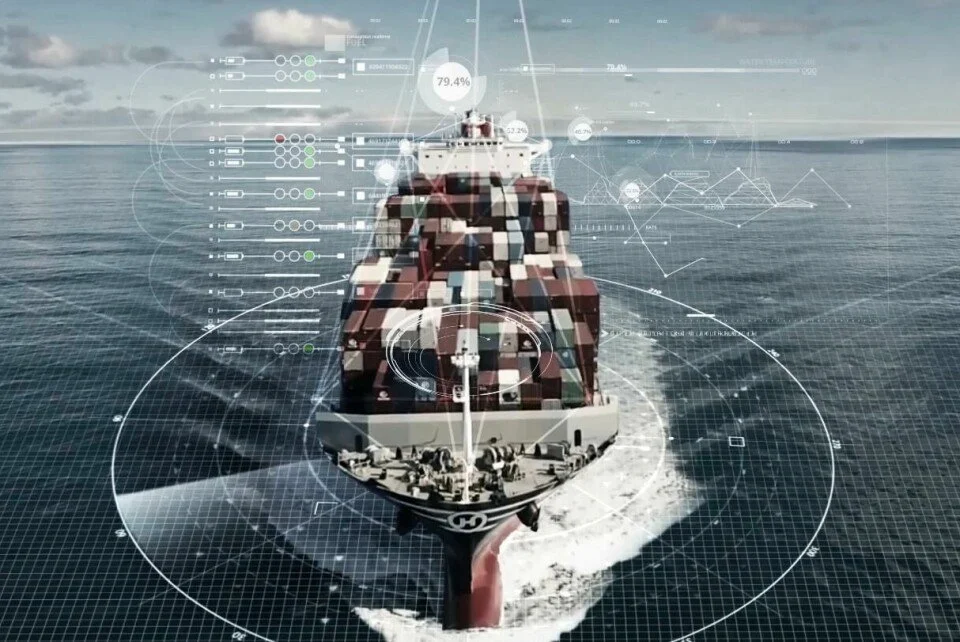
Image Credit: Automotive LOGISTICS.
Autonomous maritime vessels
Autonomous Maritime Vessels (AMVs) are often referred to as Maritime Autonomous Surface Ships (MASS) by the International Maritime Organization, and are vessels that operate with varying degrees of independence from human intervention by utilizing sensors, artificial intelligence (AI), and remote-control systems for navigation and operation.
There are four key definitions and concepts of Autonomous Maritime Vessels (AMVs):
Maritime Autonomous Surface Ships (MASS): are defined by the International Maritime Organization as ships that, to a varying degree, are capable of operating independently of human interaction, utilizing sensors, artificial intelligence (AI), and remote control for navigation. They range from automated, crewed vessels to fully autonomous, unmanned ships. These technologies are argued by the International Maritime Organization to enhance safety, efficiency, and environmental performance. The key challenges include ensuring robust communication (e.g., 99.9% availability), cybersecurity, and developing international regulations for legal, security, and operational compliance (e.g., remote control centers and crewless operations).
Autonomy vs. Automation: Autonomy is the ability of a ship to perform tasks based on environmental data without human intervention, whereas automation refers to the mechanical execution of predefined tasks. Autonomy aims to improve safety by removing human error, whereas automation enhances efficiency.
Remote Control: Remote control in maritime vessels enables operators to manage navigation, machinery, and systems from a remote/ different location (e.g., an onshore control center or from another vessel), rather than on board. Remote Operation Centers (ROC) are enabled by utilizing advanced sensors, Internet of Things (IoT), and satellite connectivity for enhanced safety, efficiency, and reduced fatigue. Remote systems help provide tools for route planning, engine monitoring, and collision avoidance. The key challenges include ensuring high-bandwidth communication for data transfer (i.e., connectivity); protecting remote systems from cyber threats (i.e., cybersecurity); and maintaining adequate visibility of the vessel’s environment for the remote operator (i.e., situation awareness).
Operational Design Domain (ODD): Operational Design Domain (ODD) in maritime vessels refers to the specific operating conditions (i.e., environmental, geographical, and situational (traffic density, route)) under which a fully or partially autonomous vessel is designed to function safely. The Operational Design Domain (ODD) defines the boundaries within which the vessel’s automated systems can operate without direct, real-time human intervention.
The International Maritime Organization has a standard classification for the degree of autonomy within maritime vessels:
Automated Process/Decision Support: Seafarers are on board to operate/control systems, but some tasks are automated.
Remotely Controlled with Seafarers: The ship is controlled from a remote location, but seafarers are on board for intervention.
Remotely Controlled without Seafarers: The ship is controlled from a remote location with no personnel on board.
Fully Autonomous: The operating system can make decisions and take actions independently.
Autonomous maritime vessels, thus, range from partially automated to fully autonomous, aimed at increasing efficiency and safety. Some of the core technologies enabling these services are: Sensors like LIDAR, RADAR, Cameras, and the Global Positioning System (GPS) for situational awareness; Artificial Intelligence (AI) and machine learning used for collision avoidance and navigation decisions, and; Communication systems (high-volume, secure, real-time data links for remote monitoring.
“ LIDAR (Light Detection and Ranging) is a remote sensing method that uses pulsed laser light to measure distances to objects and create precise, three-dimensional, digital models of the environment. “
” RADAR (Radio Detection and Ranging) is an active, contactless sensor system that detects, locates, tracks, and identifies objects (such as aircraft, ships, or terrain) by emitting electromagnetic radio waves and processing their reflections. “
Space weather
Similar to terrestrial weather occurring on Earth, the Sun has its own continuous occurrence of weather. We, therefore, see activities happening on the Sun all the time. However, sometimes these activities reach a certain level of intensity, consequently causing them to interact with the Solar System. Yet, it is the phenomena created through the interaction between the Sun and the Solar System (i.e. planets, moons and their surrounding space environment) that we call ‘space weather’. It is a condition and can be defined as a natural hazard comprising a wide range of phenomena caused by solar activities (i.e. activities happening on the Sun).
The Sun has an 11-year Solar Cycle that goes from solar minimum to solar maximum. During solar minimum we see the least number of activities causing space weather, whereas we see the opposite happening during solar maximum. However, this does not mean that we cannot experience space weather during solar minimum or a time between two solar cycles. There are different types of solar activities that can cause space weather: Solar flares, High-Speed Solar Wind Streams (HSS), Solar Energetic Particles (SEPs) and Coronal Mass Ejections (CMEs). These can cause different types of space weather impact known as Geomagnetic Storms, Solar Radiation Storms, and Radio Blackouts.
Space weather awareness is critical because solar activity can severely disrupt essential modern technology. As today’s society is getting increasingly more dependent on advanced technology within critical infrastructure, the risks and vulnerabilities to space weather impact on essential systems and services that enables modern living increases. Understanding space weather is, thus, vital for – for example - mitigation economic consequences and infrastructure damage.
To be continued …
Source
Fiori, Robyn (2022): “Development of space weather services to inform maritime users of space weather events affecting high frequency radio communication”. 44th COSPAR Scientific Assembly. Held 16-24 July, 2022. Volume 44. Online at https://www.cosparathens2022.org/. Abstract PSW.1-0001-22. Pp. 3435.
Grant, Alan; Shaw, George (2012): “The effect of space weather on maritime aids-to-navigation service provision”. Annual of Navigation. Vol. 19(1). DOI: https://doi.org/10.2478/v10367-012-0005-9?urlappend=%3Futm_source%3Dresearchgate
Xue Dabin et al. (2024): “Space weather effects on transportation systems: A review of current understanding and future outlook”. Advancing Earth and Space Science (AGU). Volume 22, Issue 12. DOI: https://doi.org/10.1029/2024SW004055
Ishii, Mamoru et al. (2024): “Space weather impact on radio communication and navigation”. ELSEVIER. Advances in Space Research. DOI: https://doi.org/10.1016/j.asr.2024.01.043
NOAA (n.d.): “HF Radio communication”. https://www.swpc.noaa.gov/impacts/hf-radio-communications#:~:text=Space%20weather%20can%20impact%20HF%20radio%20communication,enhanced%20D%2Dlayer%20that%20blocks%20HF%20radio%20communication.
Danish Maritime Authority (n.d.): “AIS data”. https://www.dma.dk/safety-at-sea/navigational-information/ais-data
Hansen, Nicholas (2023): “Situational Awareness for autonomous marine vessels”. Technical University of Denmark (DTU). https://backend.orbit.dtu.dk/ws/portalfiles/portal/338331238/PhD_thesis_260_sider_-_76_farvede.pdf
WindWard (n.d.): “Automatic Identification Systems (AIS)”. https://windward.ai/glossary/what-is-automatic-identification-systems-ais/
SKYFI (n.d.): “Vessel tracking: keeping ships on course with modern technology”. https://skyfi.com/en/blog/vessel-tracking-keeping-ships
Maritime Fairtrade (2024): “Navigating safety: importance of maritime vessel tracking systems”. https://maritimefairtrade.org/navigating-safety-importance-of-marine-vessel-tracking-systems/
Maljković, Mislav et al. (2022): ”Situational Awareness from the master point of view and importance of factors that influence it”. ResearchGate. Conference ICTS 2022. https://www.researchgate.net/publication/361735423_SITUATIONAL_AWARENES_FROM_THE_MASTER_POINT_OF_VIEW_AND_IMPORTANCE_OF_FACTORS_THAT_INFLUENCE_IT
Hansen, Nicholas (2023): “Situational Awareness for autonomous marine vessels”. Technical University of Denmark (DTU). https://backend.orbit.dtu.dk/ws/portalfiles/portal/338331238/PhD_thesis_260_sider_-_76_farvede.pdf
European Maritime Safety Agency (EMSA) (n.d.): “Maritime autonomous surface ships (MASS)”.https://www.emsa.europa.eu/mass.html
International Maritime Organization (n.d.): “Autonomous shipping”. https://www.imo.org/en/mediacentre/hottopics/pages/autonomous-shipping.aspx
Shkuro, Sophia (2023): “What is autonomous shipping?”. SEARATES by DP World. https://www.searates.com/blog/post/what-is-autonomous-shipping
Jan Rødseth, Ørnulf et al. (2017): ”Difinitions for autonomous merchant ships”. Researchgate. DOI: https://doi.org/10.13140/RG.2.2.22209.17760
United Nations Economic Commission for Europe (UNECE) (2025): “Working party on inland water transport”. https://unece.org/sites/default/files/2025-10/ECE-TRANS-SC.3-2025-inf.doc.4E.pdf
International Maritime Organization (n.d.): “Maritime safety”. https://www.imo.org/en/ourwork/safety/pages/default.aspx
