
C H A P T E R
N ° 46
The January 2026 Event
As the world gets increasingly more dependent on advanced technology - especially within critical national and global infrastructure - it increases society’s vulnerability, and thus its risk, to space weather impact. It is due to this concern that the focus on space weather awareness, research, and the search for mitigation measures has increased.
As space weather is still a quite newly recognized natural hazard compared to other hazards, recorded space weather impact is sparse and the awareness-level is generally still quite low with discussions regarding space weather often highlighting misunderstandings and misinformation. However, it is important to recognize that this natural hazard is real, and that it causes impact on critical infrastructure more often than the average citizen may be aware of.
In today’s article, we will, therefore, look closer at the January 2026 space weather event. One that has claimed its place at the top of the list of the most intense radiation storms in GOES records since the 2003 space weather event.
Video Credit: ESA: X-Class solar flare observed on 18 January 2026.
What happened?
On the 18th of January 2026, at 18.09 UTC (8.09 PM CEST), the LASCO coronagraphs onboard the ESA/NASA SOHO satellite detected a X1.9-class solar flare. X-class represents one of the most intense flares on the NOAA Space weather Scales and Benchmarks, while the number provides more information about its strength. The solar flare was followed by a fast-moving Coronal Mass Ejection (CME) with an arrival time at Earth being 25 hours, indicating a speed of approximately 1700 km/s.
During the event, high energy particles in the near-Earth space environment crossed the alarm thresholds, with the intensity of the high energy particle shower peaking at 19.15 UTC (9.15 PM CEST) on the 19th of January, 2026. The solar flare and Coronal Mass Ejection (CME) triggered a severe (i.e., level S4 in the NOAA Space weather Scales and Benchmarks) radiation storm and a severe geomagnetic storm ((i.e., level G4 in the NOAA Space weather Scales and Benchmarks) that began late on January 19, placing it at the top of the list of the most intense radiation storms in GOES records.
Radiation storms (i.e., solar proton events) and geomagnetic storms can happen at the same time, as they are both triggered by the same solar activity. Radiation storms involve high-energy particles that can reach Earth immediately, whereas geomagnetic storms occur when a Coronal Mass Ejection (CME) arrives hours or days later.
Solar Flares and Coronal Mass Ejection (CME)
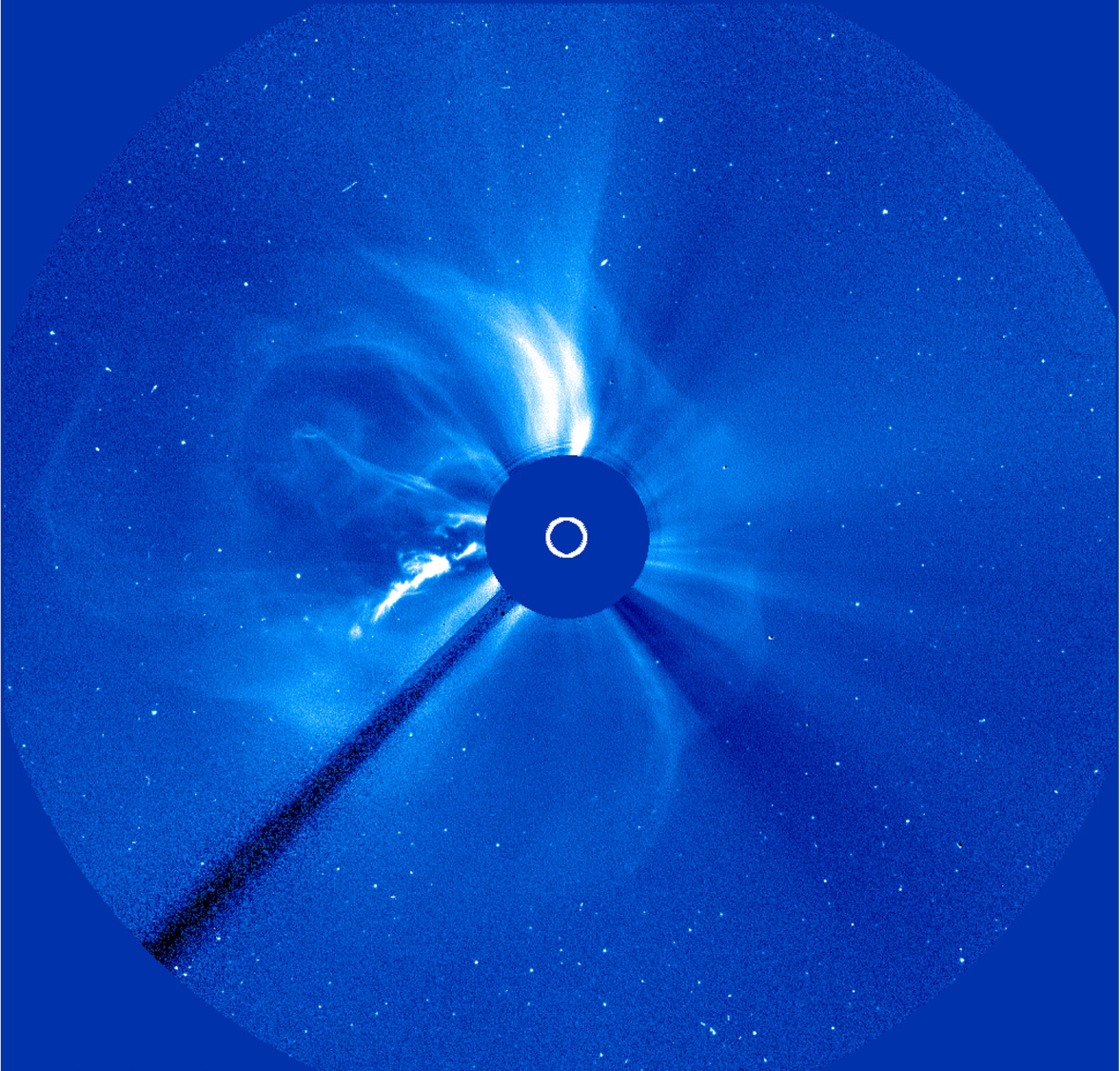
Image Credit: ESA: Solar Flare.
Solar flares are powerful bursts of energy. Flares and solar eruptions (i.e., eruptions occurring on the Sun) can impact radio communications, electric power grids, navigation signals, and pose risks to spacecraft and astronauts.
When a solar flare erupts from the Sun, the explosion can release as much energy as approximately a billion atomic bombs. Solar flares comprise of electromagnetic waves that leaves the Sun at the speed of light, and can – if Earth-directed – arrive at Earth only minutes later, potentially disrupting short-wave radio transmissions and causing errors in navigation systems.
A fraction of an hour behind, high-speed solar particles, including protons, electrons, and alpha particles, follows. High-speed solar particles can harm astronauts, damage spacecraft, and can produce a cascade of secondary particles in the Earth’s atmosphere, potentially leading to errors in electronic components if reaching the ground.
A solar flare is often – but not always – accompanied by a Coronal Mass Ejection (CME). Coronal Mass Ejections (CMEs) are large eruptions of ionised gas from the Sun’s outer atmosphere that can create gusts and shock waves in the solar wind. The travelling time of a Coronal Mass Ejection (CME) varies, but if Earth-directed, it could take anything between 18 hours to a few days before reaching the Earth.
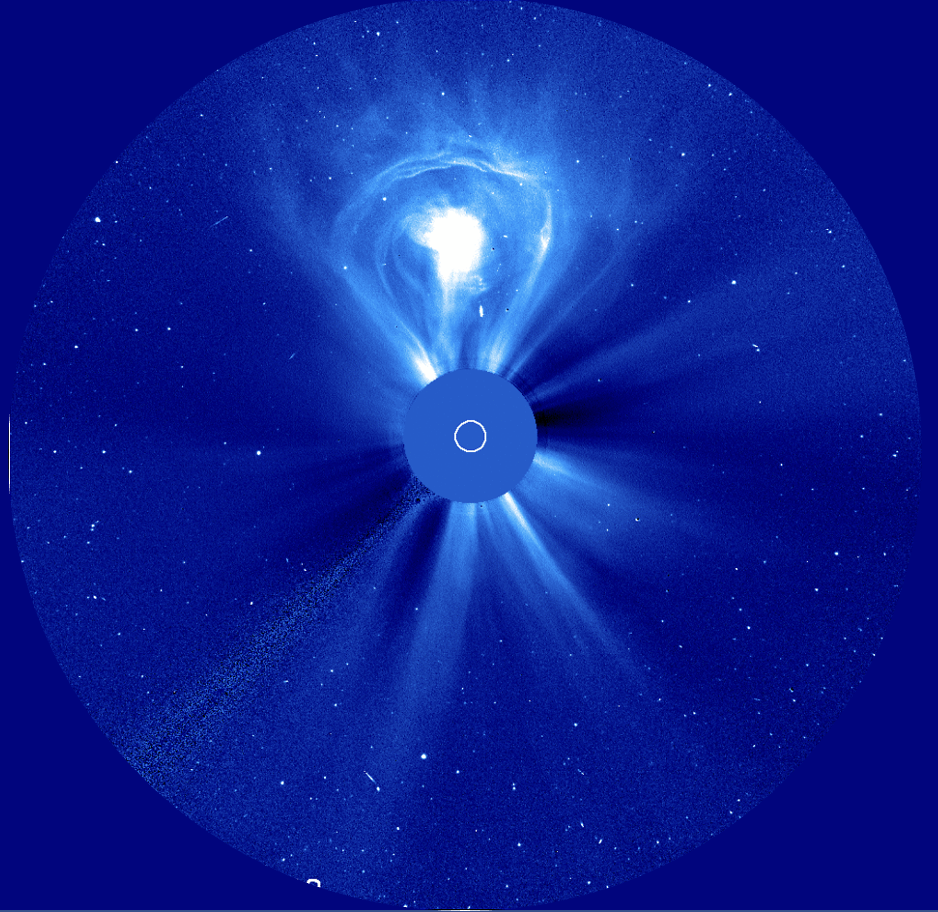
Image Credit: NASA: Coronal Mass Ejection (CME).
Coronal Mass Ejections (CMEs) can stress the Earth’s magnetic field, causing a geomagnetic storm. A geomagnetic storm is a space weather condition that can make compass needles wander, provoke damaging surges of electrical current (i.e., Geomagnetically Induced Currents (GICs) in long metallic structures like power lines and pipelines. Furthermore, during geomagnetic storms, the particles from the solar activity can find pathways to the Earth’s upper atmosphere and collide with already present atoms and molecules, creating auroras. Additionally, the interaction between the incoming particles and the Earth’s upper atmosphere causes it to heat up and make it more dense, consequently increasing its drag on low-altitude satellites (i.e., satellites within Low Earth Orbit). This can be negative and positive:
The negative: If a satellite does not compensate by using its thrusters, it can be dragged out of its orbital path, creating a risk of new space debris.
The positive: It helps drag already present space debris in the near-Earth space environment down into the atmosphere where it naturally burns up, consequently helping to “clean” the near-Earth space environment.
Space Weather Impact
The January 2026 space weather event was part of a highly active, post-peak solar cycle, with further moderate (G2-level) geomagnetic storms anticipated throughout 2026. The shock from the event caused geomagnetic conditions on and around the Earth, reaching the top of the space weather warning scales, and had the potential to affect the workload of astronauts in space, impact Earth-orbiting satellites, power grids, and aviation.
Key impacts from the event included:
Satellite and power grid risks: The severe (G4) geomagnetic storm risked disrupting satellite operations and inducing geomagnetic currents (GICs) in power grids.
Strongest radiation storm since 2003: The severe (S4) solar radiation storm caused significant high-energy particle showers, reaching over 10 protons per cubic centimeter for over an hour, threatening to interfere with spacecraft sensors and electronics.
Aviation and space hazards: Increased radiation risks for astronauts in space and airlines traveling over polar routes were reported.
Aurora activity: Severe geomagnetic storm conditions resulted in sightings of the Northern and Southern Lights (i.e., auroras) at unusually low latitudes, including throughout Europe and South Africa.
Fast moving impact: The Coronal Mass Ejection (CME) arrived at Earth only 25 hours after bursting out from the Sun, which was much faster than anticipated, indicating a need for more advanced forecasting capabilities.
In summary, the January 2026 space weather event demanded critical infrastructure operators to activate mitigation actions.
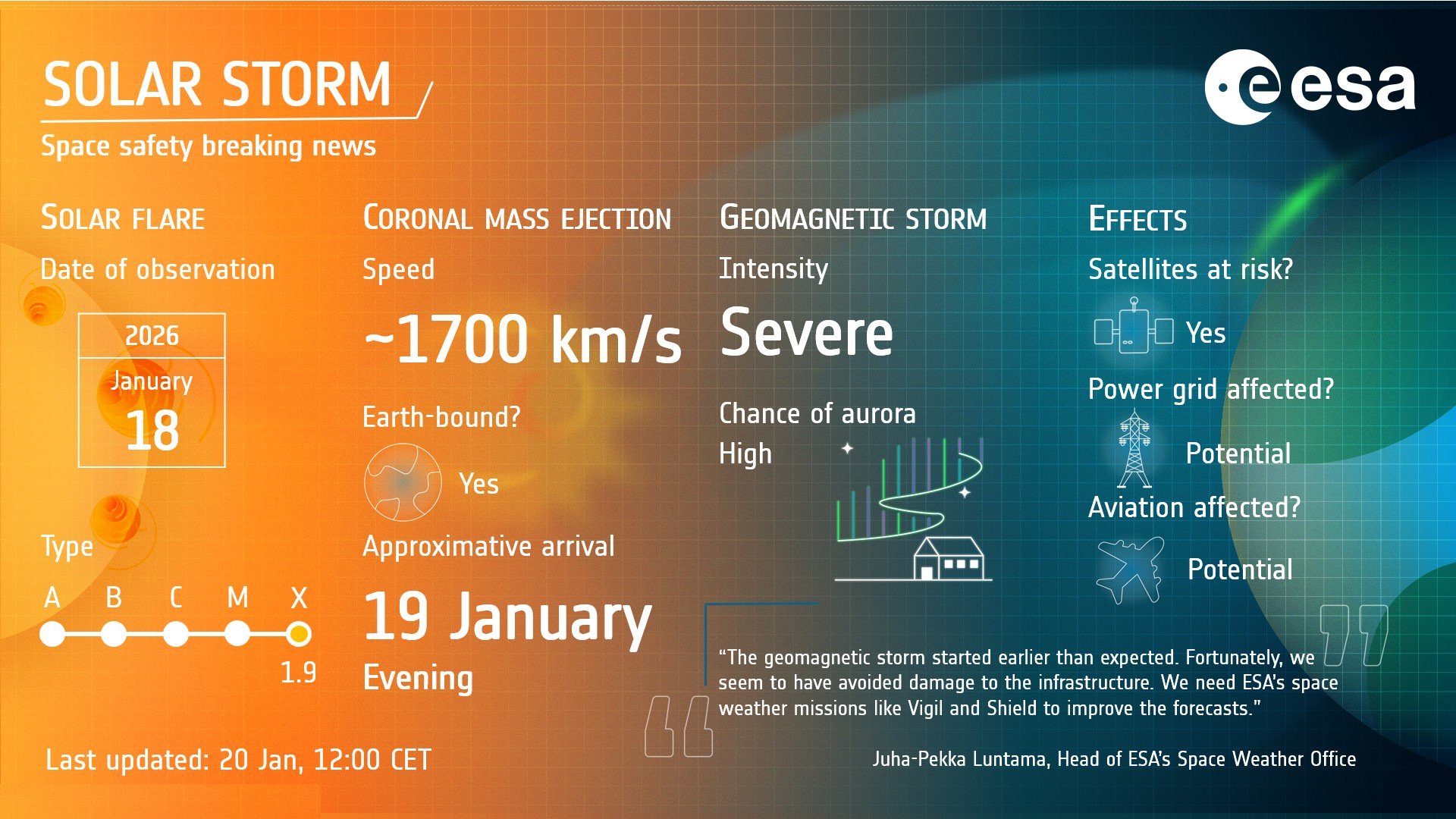
Image Credit: ESA.
Source
ESA (2026): “ESA monitoring January 2026 space weather event”. https://www.esa.int/Space_Safety/Space_weather/ESA_monitoring_January_2026_space_weather_event
EPOS-France (2026): “A major solar flare caused a geomagnetic storm and lit up the sky”. https://www.epos-france.fr/en/blog/2026/02/23/a-major-solar-flare-caused-a-geomagnetic-storm-and-lit-up-the-sky/
NASA (2026): “Strong flare erupts from the sun”. https://science.nasa.gov/blogs/solar-cycle-25/2026/01/20/strong-flare-erupts-from-sun-8/
NOAA (US): https://www.swpc.noaa.gov/phenomena
Met Office (UK): https://www.metoffice.gov.uk/weather/learn-about/space-weather/what-is-space-weather
