
C H A P T E R
N ° 47
Artificial Intelligence (AI)
In today’s article, we will look closer as the relation between space weather and Artificial Intelligence (AI). Moreover, we will present a short introduction to Artificial Intelligence (AI) and space weather, followed by a discussion on the risks and vulnerabilities that are inevitably created with the implementation of Artificial Intelligence (AI) within Critical Infrastructure (CI), focusing on space weather impact. Lastly, this article will discuss the dual relationship between space weather and Artificial Intelligence (AI), and its future.
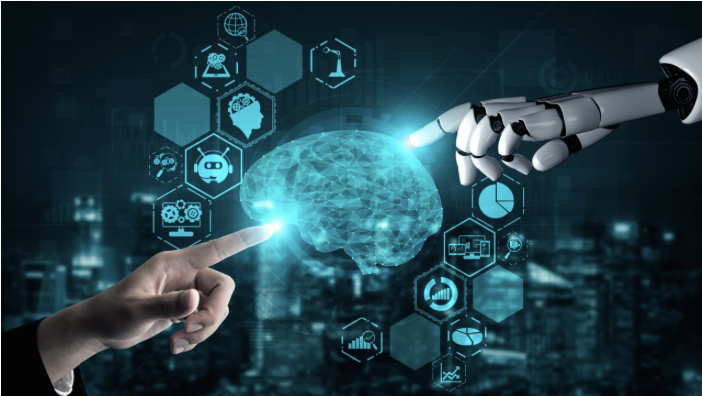
Image Credit: The ELM University of Maryland, Baltimore.
Artificial Intelligence (AI)
The field of Artificial Intelligence (AI) was founded in 1956 and has experienced cycles of high interest and reduced funding. The current boom (2010s–2020s) is driven by increased computational power (e.g., Graphics Processing Units (GPUs)) and breakthroughs in deep learning and transformer architectures.
“ A Graphics Processing Unit (GPU) is a specialized electronic circuit designed to rapidly manipulate memory to accelerate the creation of images, videos, and 3D graphics. Graphics Processing Units (GPUs) use thousands of smaller, specialized cores to perform many tasks simultaneously (parallel processing), making them essential for gaming, Artificial Intelligence (AI), and data-intensive computing. ”
Artificial Intelligence (AI) is a technology and a field of computer science dedicated to creating systems capable of performing tasks that typically require human intelligence, such as reasoning, learning, problem-solving, and perception. Modern Artificial Intelligence (AI) leverages machine learning, deep learning, and neural networks to analyze vast datasets, identify patterns, and make predictions.
Technology equipped with Artificial Intelligence (AI) can see and identify objects, understand and respond to human language, learn from new information and experience, make detailed recommendations to users and experts, and act independently. It, thus, has the potential to replace the need for human intelligence or intervention. Classic examples of this would be self-driven (i.e., autonomous) vehicles or aircrafts.
To fully understand Artificial Intelligence (AI), it is important to understand the technologies on which Artificial Intelligence (AI) – or more specifically ‘generative Artificial Intelligence’ (gen AI) - tools, are built on; Machine Learning (ML) and Deep Learning.
Generative Artificial Intelligence (gen AI):
Generative Artificial Intelligence (AI), also called ‘gen AI’, is Artificial Intelligence (AI) that can create original content like text, images, video, audio, or software code in response to a user’s prompt or request. It relies on sophisticated machine learning models called ‘deep learning algorithms’. These simulate the learning and decision-making processes of the human brain. The models work by identifying and encoding the patterns and relationships in vast amounts of data, whereby it uses that information to understand user’s natural language requests or questions, and respond accordingly with new content.
Machine Learning (ML):
Machine Learning (ML) provides the backbone of most modern Artificial Intelligence (AI) systems, from forecasting models to autonomous vehicles to Large Language Models (LLMs) and other Artificial Intelligence (AI) tools. Machine Learning (ML) is the division of Artificial Intelligence (AI) that focus on algorithms that can “learn” the patterns of training data and make accurate inferences about new data. The pattern recognition ability enables Machine Learning (ML) models to make decisions and/or perditions without explicit, hard-coded, instructions.
“ Large Language Models (LLMs) are advanced Artificial Intelligence (AI) systems designed to understand, generate, and summarize human language by analyzing massive datasets. They are a type of deep learning model, often based on transformer architectures, that learn patterns to predict and generate text, enabling applications like chatbots, translation, and content creation. “
Deep Learning:
Deep Learning is a subset of Machine Learning (ML) that is driven by multilayered neural networks whose design is inspired by the structure of the human brain. Deep Learning models power most of modern Artificial Intelligence (AI), such as computer vision, Generative Artificial Intelligence (gen AI), autonomous cars, and robotics.
“ A neural network is a machine learning model that stacks simple "neurons" in layers and learns pattern-recognizing weights and biases from data to map inputs to outputs. “
Unlike the explicitly defined mathematical logic of traditional machine learning algorithms, the artificial neural networks of deep learning models comprise many interconnected layers of “neurons” that each perform a mathematical operation. By using machine learning to adjust the strength of the connections between individual neurons in adjacent layers, the network can be optimized to yield more accurate outputs.
Space Weather
Similar to terrestrial weather occurring on Earth, the Sun has its own continuous occurrence of weather. We, therefore, see activities happening on the Sun all the time. However, sometimes these activities reach a certain level of intensity, consequently causing them to interact with the Solar System. Yet, it is the changing environmental conditions created through the interaction between the Sun and the Solar System (i.e., planets, moons, and/or their surrounding space environment) that we call ‘space weather’. It is a condition and can be defined as a natural hazard comprising a wide range of phenomena caused by solar activities (i.e., activities happening on the Sun).
There are different types of solar activities that can cause space weather, some of which are:
Solar flares: are huge impulsive eruptions causing rapid release of plasma (UV and X-ray radiation) into the Solar System. The key impact from this type of solar activity is radio blackouts occurring at different severity levels; minor, moderate, strong, severe or extreme storm.
Coronal Mass Ejections (CMEs): are large explosions of plasma and magnetic field from the Sun thrown into space. The key impact from Coronal Mass Ejections (CMEs)are geomagnetic storms occurring at different severity levels; minor, moderate, strong, severe or extreme storm.
High-Speed Solar Wind Streams (HSSs): High-Speed Solar Wind Streams are constant streams of plasma flowing out of regions on the Sun comprising of magnetic field that connects out to interplanetary space. The key impact from this solar activity is geomagnetic storms occurring at different severity levels; minor, moderate, strong, severe or extreme storm.
Space weather can impact environments, systems, and technologies on Earth and in space. Examples of effects are: electrical blackouts, damaged spacecraft electronics, increased radiation exposure to astronauts, and pilot and crew onboard polar flights, and disruption to telecommunication.
Risks and Vulnerabilities
Space weather has a dual relationship with Artificial Intelligence (AI) as it poses a significant threat to the hardware and infrastructure that runs Artificial Intelligence (AI), while it, simultaneously, also has become a crucial and transformative tool for forecasting those very same threats, which helps in mitigating the risk of space weather impact on critical infrastructure (CI).
Artificial Intelligence (AI) is primarily driven by massive amounts of data, advanced algorithms (e.g., Machine Learning (ML)), and immense computing power. However,whilst satellites are not the ‘driver’ of Artificial Intelligence (AI) technology itself, they are still a critical datasourceand a rapidly growing applicationarea for Artificial Intelligence (AI). Radiation and geomagnetic storms caused by solar activity can emit high-energy particles (X-rays, gamma rays) which can cause ‘Singe-Event Upsets’ (SEU) (i.e., bit flips in memory) which led to damage on satellite electrons, consequently leading to corrupt data in Artificial Intelligence (AI) processors and memory systems and/or malfunction on Earth and in space. An example where this has happened is during the 2022 space weather event. Here, solar activity leading to a geomagnetic storm (i.e., space weather) conditions in the near-Earth space environment, caused the loss of 40 Starlink (SpaceX) satellites.
“ A Single-Event Upset (SEU) is a non-destructive, soft error in microelectronic devices where a single ionizing particle (e.g., a cosmic ray or neutron) strikes a sensitive node, causing a bit-flip - a change of state from 0 to 1, or 1 to 0 - in memory or logic. “
Furthermore, Artificial Intelligence (AI) deployed on satellites for real-time image processing or autonomous navigation can be disabled, losing valuable data and decision-making capabilities.
Intense space weather events, such as those that occurred during the peak of solar cycle 25 (around 2025–2026), can cause satellite malfunctions, satellite failure in up to approximately 10% of satellites, disrupt power grids, and affect Artificial Intelligence (AI)-driven infrastructure. Intense geomagnetic storms caused by solar activities like Coronal Mass Ejections (CMEs) and High-Speed Solar Wind Streams (HSSs) can create Geomagnetically Induced Currents (GICs) that can damage ground-based (terrestrial) data centers, power grids, and terrestrial internet connectivity, consequently interrupting the massive, continuous power supply required to train and run large-scale Artificial Intelligence (AI) models. Furthermore, as space exploration increases, Artificial Intelligence (AI) systems are increasingly more used for autonomous rovers and satellites. However, these technologies and systems are directly exposed to harsh radiation during space weather events, increasing the risk of loss of or incorrect data, malfunctions etc., consequently necessitating hardening techniques.
The impact of space weather on Artificial Intelligence (AI) technology, thus, spans from satellite damage and data loss, to disruption of ‘edge’ Artificial Intelligence (AI), to terrestrial infrastructure disruptions, to general data vulnerability.
“ Edge Artificial Intelligence (AI) is the deployment of Artificial Intelligence (AI) algorithms directly on local devices (e.g., Internet of Things (IoT) sensors, smartphones, and autonomous vehicles) rather than in a centralized cloud. Internet of Things (IoT) sensors are specialized electronic hardware devices that detect, measure, and collect data on physical environmental parameters (e.g., temperature, motion, or light), and convert them into digital signals. They are crucial for connecting physical objects to digital networks, enabling automation and real-time monitoring. A centralized cloud is a computing model where data, applications, and processing power are managed and stored in a single, primary location —typically a massive, corporate-owned data center. Examples include major providers like AWS, Microsoft Azure, and Google Cloud. “
As mentioned earlier, space weather has a dual relationship with Artificial Intelligence (AI). This means, that there are also advantageous of utilizing Artificial Intelligence (AI). Artificial Intelligence (AI) and Machine Learning (ML) are actively improving the ability to predict and prepare for space weather events, which is an essential part of achieving space weather resilience.
Artificial Intelligence (AI) models can predict solar wind conditions up to four days in advance with high accuracy. A new Artificial Intelligence (AI) system from, for example, NYU Abu Dhabi has demonstrated an improvement in forecasting accuracy compared to traditional models with approximately 45%. Furthermore, Artificial Intelligence (AI) programmes like the ‘Solar Transient Recognition Using Deep Learning (STRUDL)’, can automatically detect and analyse solar storms from image data, which, if done the traditional way, is a time-consuming manual task.
In addition, Artificial Intelligence (AI) provides advanced modeling. Long Short-Term Memory (LSTM) networks and Support Vector Machines (SVM) can be used to detect long-term patterns in solar cycles and, thereby, forecast geomagnetic disturbances like the Kp index which measures global geomagnetic activity on a scale from 0-9, informing about disturbances in Earth’s magnetic fields caused by solar activity. The Kp index helps determine the strength of the aurora and potential disruptions to satellite, radio, and power grid technology.
“ Long Short-Term Memory (LSTM) is an advanced type of Recurrent Neutral Network (RNN) designes to model sequential data by learning long-term dependencies, solving the vanishing gradient problem of traditional Recurrent Neutral Networks (RNNs). “
“ Support Vector Machines (SVM) are powerful, supervised machine learning models used for classification, regression, and outlier detection. They operate by finding the optimal hyperplane—a decision boundary—that maximizes the margin (distance) between different data classes, ensuring high generalization on unseen data. “
A new Artificial Intelligence (AI) foundation model called "Surya", developed by NASA and IBM, has been designed to analyze solar observation data, and to better predict the impact of solar activity on technological systems. In addition to this, Artificial Intelligence (AI)-based tools are similarly being developed to monitor satellite radiation levels and provide real-time alerts to safeguard technological infrastructure.
Future Outlook
With the current solar cycle expected to peak around 2025–2026, the reliance on Artificial Intelligence (AI) for predictive analytics has grown. The future involves hybrid systems, combining physics-based modeling with Artificial Intelligence (AI), to increase prediction lead times and accuracy, mitigating the risk of things such as a mega disaster or, in the worst-case scenario, a "civilization-level disaster", caused by extreme space weather.
The modern-day society is getting increasingly more dependent on advanced technologies within its critical infrastructure (CI). The vulnerability to space weather impact follows the level of dependency a society has on advanced technologies within its critical infrastructure. This means, that the more a society depends on advanced technology, the higher is the risk of space weather having deep impact on the society. This is if the correct mitigation measures are not created and/or implemented.
Through this article we have discussed the dual relationship between space weather and Artificial Intelligence (AI). Artificial Intelligence (AI) is becoming a more integrated tool within critical infrastructure (CI). This uprising of a dependency on this tool gives rise to questions such as: “How does space weather impact the functionality and security of Artificial Intelligence (AI)?” and; “How high are the risks?”. Answering these and similar questions, and, thereby, questioning the use of Artificial Intelligence (AI) within critical infrastructure (AI) should be the first step when considering the implementation of such advanced tools. The development and integration of services and capabilities enabled by advanced technology is inevitable. However, they must be implemented with the foundational goal of being safe, secure, and resilient, and with knowledge and an awareness of the vulnerability and risks they may present to critical infrastructure and, thus, society.
Source
Samuel, Arthur L. (1959): “Some Studies in Machine Learning Using the Game of Checkers”. BM Journal. MIT. https://people.csail.mit.edu/brooks/idocs/Samuel.pdf
Chrismes, Dillon (2023): “Using Decision Trees as an Expert System for Clinical Decision Support for COVID-19,“. Interactive Journal of Medical Research, Vol 12, 30. DOI: https://doi.org/10.2196/42540
Hecht-Nielsen, Robert (1987): “Kolmogorov’s Mapping Neural Network Existence Theorem,“ Proceedings of the IEEE First International Conference on Neural Networks. https://cs.uwaterloo.ca/~y328yu/classics/Hecht-Nielsen.pdf
Leshno, Moshe et al. (1992): “Multilayer Feedforward Networks with a Non-Polynomial Activation Function Can Approximate Any Function“. Center for Research on Information Systems (New York University). https://archive.nyu.edu/bitstream/2451/14329/1/IS-92-13.pdf
McKinsey & Company (2023): “The state of AI in 2023: Generative AI’s breakout year”. https://www.mckinsey.com/capabilities/quantumblack/our-insights/the-state-of-ai-in-2023-generative-ais-breakout-year
STAMFORD (2023): “Gartner Says More Than 80% of Enterprises Will Have Used Generative AI APIs or Deployed Generative AI-Enabled Applications by 2026”. Gartner. https://www.gartner.com/en/newsroom/press-releases/2023-10-11-gartner-says-more-than-80-percent-of-enterprises-will-have-used-generative-ai-apis-or-deployed-generative-ai-enabled-applications-by-2026
NOAA SWPC (n.d.): ”Space weather phenomena”. https://www.swpc.noaa.gov/phenomena
Met Office (n.d.): “Space weather”. https://weather.metoffice.gov.uk/specialist-forecasts/space-weather
Thaker, Prayag et al. (2025): “Evaluating AI approaches for space weather prediction: Strengthening satellite resilience and technology systems”. KeAI Chinese Roots Global Impact. ScienceDirect. Journal of Space Habitation. Vol 1, Iss. 3. DOI: https://doi.org/10.1016/j.spaceh.2025.100032
NYUA ABU DHABI (2025): “NYUA scientists use AI to forecast harmful solar winds days in advance”. NYU ABU DHABI. https://nyuad.nyu.edu/en/news/latest-news/science-and-technology/2025/september/nyuad-scientists-ai-forecast-solar-winds.html
