
C H A P T E R
N ° 50
The Banking Sector (Part 1)
Space weather poses significant systemic risks to the financial sector through infrastructure disruption and behavioral impacts on trading. Extreme events can trigger global economic losses, with Lloyds of London estimating scenarios of up to $2.4 trillion.
The banking sector (sub-sector) is the foundational service industry that manages money, credit, and financial transactions for individuals, businesses, and governments within the financial sector. Its core function is to take deposits and channel these funds into loans and investments, fueling economic growth and market stability.
In today’s article, we will look closer at the relation between space weather and the banking sector. This article will be part 1 of 2 articles focusing on this topic. Combined the articles will explore the effects of space weather on physical infrastructure (systemic volatility) used within the banking sector, as well as behavioral psychology and sentiment (market returns).
In this article;C H A P T E R N ° 50 The Banking Sector (Part 1), we will start by looking closer at the physical critical infrastructure disruptions (Systemic volatility).
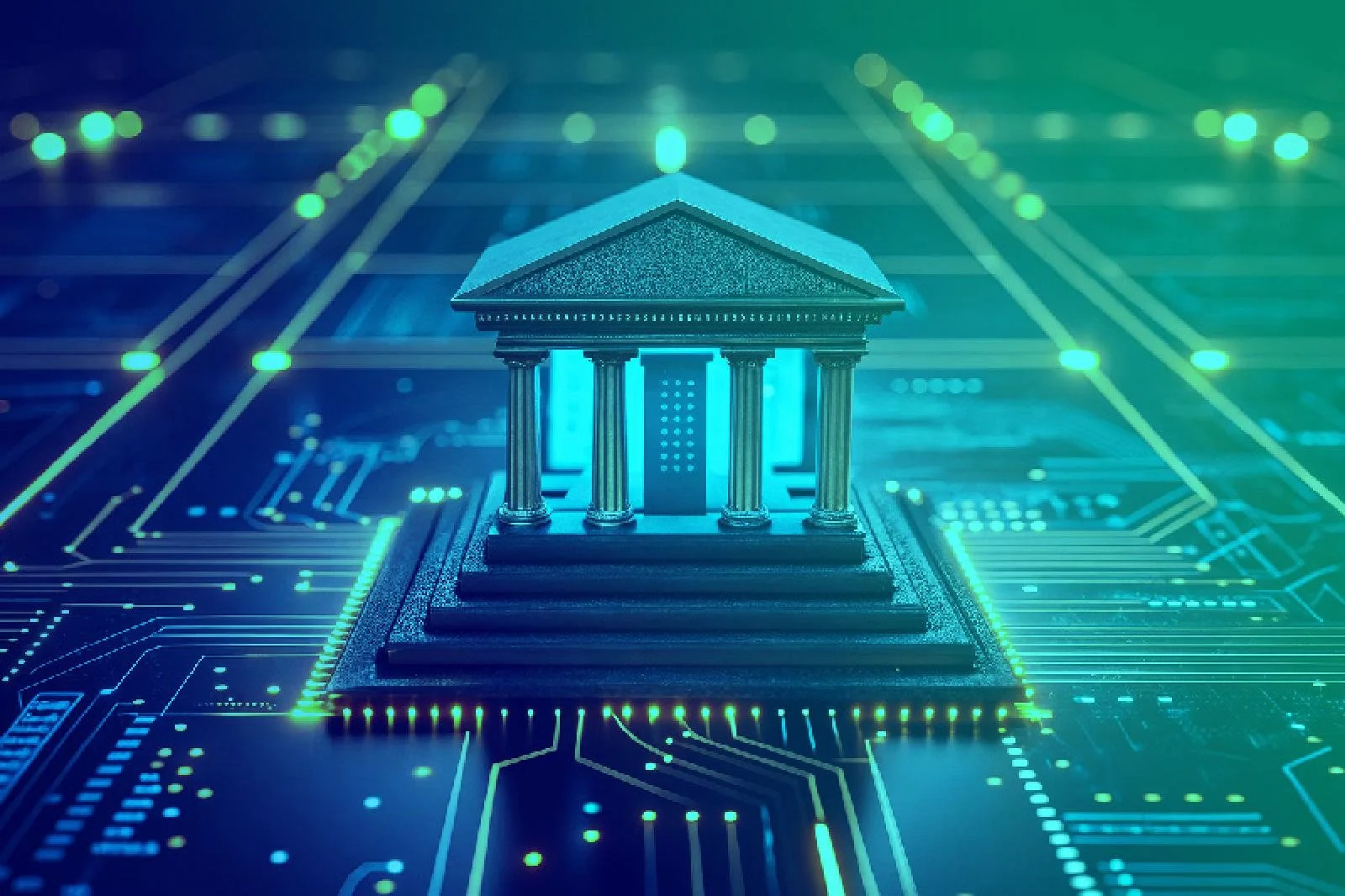
Image Credit: Nopadon-stock.adobe.com.
1. Physical Infrastructure Disruptions (Systemic Volatility)
The banking industry is typically divided into three key specialized areas: 1) Retail Banking, which service everyday consumers and small businesses by providing checking/savings accounts, personal loans, and residential mortgages; 2) Corporate Banking, which handles the financial needs of mid-market and large enterprises, including commercial loans, trade financing, and cash management; and 3) Investment Banking, which assists corporations and governments in raising capital through stocks and bonds, and provides advice on complex mergers and acquisitions.
These key pillars are all undergoing a transformation, characterized by: 1) Digitalization, where a steady decline is being made in physical branch networks as banking shifts to digital-only platforms, mobile apps, and automated systems; 2) Technology integration, with the rise of financial technology (FinTech) competitors and the increasing use of artificial intelligence (AI) for credit risk assessment and customer service; and 3) Consolidation, due to the total number of credit institutions in Europe that continues to shrink as banks merge to increase efficiency and adapt to evolving regulations.
This change, is what increases the banking sectors vulnerability and risk of space weather impact. Digitalization is the use of digital technologies and data to shift organizations from manual, analog processes to interconnected, data-driven systems. Ultimately, digitalization alters how value is delivered to customers. These modern digital systems depend on the energy sector and on space infrastructures like satellites, particularly for precise timing, global navigation, and remote communication. While most international data travels through undersea cables, satellites provide the invisible backbone that keeps critical global infrastructure synchronized, provides remote connectivity and vital backup networks to maintain financial operations during terrestrial internet or fiber-optic cable outages, and helps within risk analysis.
As the sector becomes more digitalized, the rise of financial technologies (FinTech) has increased, causing an integration of innovative software, algorithms, and digital platforms to automate and improve financial services. Financial technologies have led to replacement of traditional, in-person banking and paper-heavy processes, making everyday transactions and wealth management faster, cheaper, and more accessible. Moreover, a consequence of digitalization within the banking sector has been bank consolidation decreasing the number of in-person physical banks, which increases the dependency on the digital systems and technologies.
Space infrastructure and services
Modern banking relies on space infrastructure in order to function properly. Satellites provide the invisible backbone that keeps critical global infrastructure synchronized, provides remote connectivity, and vital backup networks to maintain financial operations during terrestrial internet or fiber-optic cable outages, and helps within risk analysis.
However, satellites are one of the most vulnerable critical infrastructures to space weather impact. Here are some of the risks and vulnerabilities associated with space weather impact on satellites and the banking sector:
Disrupted timing and settlement: Desynchronization of network clocks:
Financial institutions and stock exchanges depend on microsecond and nanosecond accuracy to sequence millions of trades and verify account balances globally. This timing is largely sourced from the Global Positioning System (GPS)/Global Navigation Satellite System (GNSS) satellite networks. Space weather can disrupt the ionosphere - a dynamic region of the Earth's upper atmosphere (60-1000 km above the surface) -, consequently causing radio wave scintillation and signal delays. This desynchronizes the internal clocks of bank servers and ATM network. When transaction timestamps mismatch across networks, automated trading platforms and clearinghouses may be forced to suspend operations in order to prevent processing massive, irreconcilable errors. Space weather can, thus, compromise transaction records and cause errors in global financial clearing and settlement networks.
Furthermore, interbank payments and cross-border settlements operate on strict, continuous timing windows. If timing signals are degraded and network communication lines are affected, clearing banks and central depositories cannot definitively confirm the validity of funds in transit. This causes immediate issues within liquidity (e.g., issues with customer withdrawals, loan demands, day-to-day operating expenses) and fails to meet strict intraday settlement deadlines, potentially freezing short-term money markets.
Telecommunication blackouts:
Space weather can disrupt the Earth’s ionosphere, consequently interfering with high-frequency radio waves and satellite communications. This interference can interrupt the vital data links needed for international trading, cross-border payments, and branch-to-branch communications. When telecommunication blackouts or disturbances occur, financial institutions can face instant payment processing failures, severely limited ATM operations, and halted global trading.
Space weather, thus, disrupts the banking sector primarily by compromising the Global Navigation Satellite Systems (GNSS/GPS), which modern financial systems rely on for highly synchronized timing data. This loss of precise timing signals and communication capabilities can severely delay, misalign, or halt electronic transactions, leading to cascading failures in daily clearing and settlement operations.
Infrastructure vulnerability: The energy sector
Space weather, particularly in the form of severe geomagnetic storms, can pose a severe threat to the banking sector primarily by inducing Geomagnetically Induced Currents (GICs) into electrical transmission lines, which can overload transformers, leading to widespread, long-term power outages or power grid system failures. Modern finance depends entirely on uninterrupted electricity and digital networks. Therefore, a prolonged blackout caused by space weather would bring all banking, trading, and monetary services (e.g., credit and debit card networks) to an immediate halt.
When massive ejections of solar plasma strike Earth’s magnetic field, they can distort the field and induce currents directly into the ground. These induced currents can seep into long-distance, high-voltage transmission lines and overload extra-high voltage transformers, consequently permanently damage, overheat, or melt critical grid hardware. The overload can trigger protective grid safety trips, leading to widespread, multi-regional power outages.
The loss of electrical power translates into immediate economic shocks:
Digital freezes: ATMs, online banking portals, point-of-sale systems, and credit card networks instantly go offline. This halts virtually all consumer and corporate transactions.
Satellite issues: High-frequency financial trading and secure wire transfers rely heavily on timing signals from Global Navigation Satellite Systems (GNSS/GPS) and communication satellites. However, the satellite and energy sector interconnected. An issue within the power grid system would, therefore, have an impact on the availability and utilization of satellite services.
Data center failures: While banks utilize backup generators, a long-term grid failure could force operations offline, consequently crippling communication networks, record-keeping, and security protocols.
Loos of confidence: The inability to customers to access funds or businesses to process payroll could trigger liquidity crises and significant macroeconomic instability.
Disrupted supply chains:
Satellite services and the energy sector are foundational to modern society. Prolonged blackouts stemming from space weather can, therefore, additionally severely disrupt critical logistics and supply chains. This would create indirect systemic risks for banking portfolios and corporate lending.
Consolidation: Why Fewer Physical Branches Hurts
Bank consolidation reduces the number of players in the financial sector, meaning that individual institutions control a larger share of assets. When an incredibly large bank fails, it directly imposes losses on other institutions, consequently putting immense strain on the entire economy. Such failures or liquidity crises create widespread doubt about the health of the broader financial system. When fewer banks dominate the landscape, it limits the options for consumers and smaller businesses. Over-concentration limits the diversity of business models, making the financial sector less adaptable to external market shocks. Moreover, supervisors often monitor consolidation efforts to ensure that systemic risks are managed, but larger and more complex banking institutions can result in making regulatory oversight more difficult.
The combination of bank consolidation and digitalization (i.e., having fewer in-person physical banks) increase societal vulnerability to space weather. Physical branches provide a critical offline backup if space weather disrupt the technological infrastructure that modern digital banks rely on. When society relies strictly on digital, cloud-based banking, space weather can abrupt freeze all commerce and access to funds. In contrast, a robust network of physical banks offers the necessary fallback for consumers and businesses to make emergency withdrawals, process paper records, and access capital until technological systems are fully restored and reliable. Because, like extreme climate risks, space weather poses a systemic threat to financial stability.
To be continued …
Source
Green, Lucie etal. (2016): “Building space weather resilience in the finance sector”. University College London Department of Space and Climate Physics. ResearchGate. DOI: https://doi.org/10.13140/RG.2.2.32458.21443
European Comission (n.d.): “Banking sector and financial stability”. European Semester Thematic Factsheet. https://commission.europa.eu/document/download/16aec668-c86b-47c6-a6d2-062b3a96e515_en?filename=european-semester_thematic-factsheet_banking-sector-financial-stability_en.pdf
Hall, Mary (2025): “The role and impact of the banking sector on the global economy”. Investopedia. https://www.investopedia.com/ask/answers/032315/what-banking-sector.asp
University College London (2016): “Building space weather resilience in the finance sector”. UCL Insights: Research Briefing. University College London. https://www.ucl.ac.uk/public-policy/sites/public_policy_redesign/files/pp_insights_research_briefing_-_space_weather_jul2016.pdf
Krausmann, Elisabeth et al. (2014): ”Space weatrher and financial systems: finding and outlook. An event co-organised by the European Comission’s Joint Research Centre, the UK Civil Contingencies Secretariat and the NOAA Space Weather Prediction Centre 27 June, 2014, London, UK”. JRC Publications. DOI: https://dx.doi.org/10.2788/18855
SANSA et al. (2017): “Economic impact of space weather”. SANSA Policy Brief. SANSA and Republic of South Africa Department of Science & Innovation. https://www.sansa.org.za/wp-content/uploads/2024/09/Economic-Impact-of-Space-Weather-April-2017.pdf
Green, Lucie (2016): “How space weather poses a risk to the finance industry”. The Conversation. https://theconversation.com/how-space-weather-poses-a-risk-to-the-finance-industry-64621
GFZ Helmholtz Centre for Geosciences (n.d.): ”Impact on technologies: impacts of space weather on technologies”. GFZ Helmholtz Centre for Geosciences. https://www.gfz.de/en/spotlights/space-weather/impact-on-technologies
Robotti, Cesare et al. (2003): “Playing the field: Geomagnetic storms and the stock market”. Federal Reserve Bank of Atlanta. Working Paper 2003-5b. DOI: https://dx.doi.org/10.2139/ssrn.375702
Wang, Connie X. et al. (2019): “Transduction of the Geomagnetic Field as Evidenced from alpha-Band Activity in the Human Brain”. eNeuro. 6(2):ENEURO.0483-18.2019. DOI: https://doi.org/10.1523/eneuro.0483-18.2019
National Research Council (2008): “Severe Space Weather Events–Understanding Societal and Economic Impacts: A Workshop Report”. Washington, DC: The National Academies Press. DOI: https://doi.org/10.17226/12643
AON (n.d.): “When the Sun strikes: preparing for the business impact of geomagnetic storms”.
https://aon.co.nz/AonNZ/media/Docs/27555-Geomagnetic-Storms-Insights-Whitepaper_v6-0.pdf
Fernholz, Tim (2022): “The entire global financial system depends on GPs, and it’s shockingly vulnerable to attack”. Tech & Innovation. QUARTZ. https://qz.com/1106064/the-entire-global-financial-system-depends-on-gps-and-its-shockingly-vulnerable-to-attack
The Economic Times (n.d.): “Internet, GPS system to be stopped by solar storm? Here's what researcher has claimed”. The Economic Times. https://economictimes.indiatimes.com/news/international/us/internet-gps-system-to-be-hampered-by-solar-storm-heres-what-researcher-claims/articleshow/105193622.cms?from=mdr
Oughton, Edward et al. (2017): “Quantifying the daily economic impact of extreme space weather due to failure in electricity transmission infrastructure”. AGU. Space Weather Journal Vol. 15, Issue 1. DOI: https://doi.org/10.1002/2016SW001491
Pinhasov, Igal (2024): “Are your GNSS systems ready for solar maximum? Here’s how to strengthen resilience against solar weather”. Technically Speaking Powered by ADTRAN. https://www.blog.adtran.com/en/are-your-gnss-systems-ready-for-solar-maximum
Ruffle, Simon (2016): “Understanding the economic impact of space weather risks”. Strategic RISK. https://www.strategic-risk-global.com/esg-risks/understanding-the-economic-impact-of-space-weather-risks/1419210.article
Lloyd's (n.d.): “Solar storm risk to the North American electric grid”. Lloyd's and the Atmospheric and Environmental Research, Inc. https://assets.lloyds.com/assets/pdf-solar-storm-risk-to-the-north-american-electric-grid/1/pdf-Solar-Storm-Risk-to-the-North-American-Electric-Grid.pdf
Tong, Yin et al. (2026): “Impact of space weather on electricity power grids: A review on economic consequences and National policy”. Frontiers. Astronomy and Space Sciences, Space Physics. https://www.frontiersin.org/journals/astronomy-and-space-sciences/articles/10.3389/fspas.2026.1733091/abstract
Lloyd’s (n.d.): “Extreme space weather, Shining a light on solar storms”. https://assets.lloyds.com/media/dea751c7-e4c5-4b12-9e40-a62971b8ad82/Lloyds_SolarStormsReport_3pp.pdf
Krivelyova, Anna et al. (2003): “Playing the field: Geomagnetic storms and international stock markets”. Working Paper. Federal Reserve Bank of Atlanta, GA. No. 2003-5a. https://www.econstor.eu/bitstream/10419/100979/1/wp2003-05a.pdf
Robotti, Cesare et al. (2003): “Playing the Field: Geomagnetic storms and the stock market”. ResearchGate. SSRN Electronic Journal. DOI: https://doi.org/10.2139/ssrn.375702
Brooks, Crystal (2025): “Effects of solar flares on Forex Market volatility”. Cospar2020. https://www.cospar2020.org/effects-of-solar-flares-on-forex-market-volatility/
Despond, Besile (2018): “Geomagnetic storms and stock market”. Department Physics, ETH Zürich. https://ethz.ch/content/dam/ethz/special-interest/mtec/chair-of-entrepreneurial-risks-dam/documents/dissertation/Despond%20Basile%20geomagnetic%20storms%20and%20the%20stock%20market.pdf
Krausmann, Elisabeth et al. (2013): “Space Weather and Power Grids: Findings and Outlook”. JRC Scientific and policy reports. European Commission. https://www.google.com/url?sa=t&source=web&rct=j&opi=89978449&url=https://publications.jrc.ec.europa.eu/repository/bitstream/JRC86658/lbna26370enn.pdf&ved=2ahUKEwiaqcy73uqUAxXPGRAIHY8LAKcQFnoECBcQAQ&usg=AOvVaw1V6xq0plVqy8t_7Ez-tFLy
European Central Bank (2020): “Guide on the supervisory approach to consolidation in the banking sector”. European Central Bank, Banking Supervision. https://www.bankingsupervision.europa.eu/ecb/pub/pdf/ssm.guideconsolidation2101~fb6f871dc2.en.pdf
Mishkin, Frederic S. et al. (1999): ”Financial consolidation: Dangers and opportunities”. ScienceDirect. Journal of Banking and Finance. Vol. 23 Issue 2-4. Pp. 675-691. DOI: https://doi.org/10.1016/S0378-4266(98)00084-3
Bank for International Settlements (n.d.): “Chapter III: Effects of consolidation on financial risk”. Bank for International Settlements. https://www.bis.org/publ/gten05ch3.pdf
Bank for International Settlements (n.d.): “Chapter VI: the fffects of consolidation on payment and settlement systems”. Bank for International Settlements. https://www.bis.org/publ/gten05ch6.pdf
International Monetary Fund (2001): “Consolidation in the financial sector: summary report”. Bank for International Settlements and International Monetary Fund. ISBN: 92-9131-612-1 https://www.imf.org/external/np/g10/2001/01/eng/pdf/fscssum.pdf
Nicolo, Gianni De et al. (2202): ”Systemic risk and financial consolidation: are they related?”. ScienceDirect. Journal of Banking and Finance. Vol. 26. Issue 5. Pp. 861-880. DOI: https://doi.org/10.1016/S0378-4266(02)00211-X
Kam, Warren, Wai Tong (2025): “Solar influences on financial markets: toward smarter investment decisions across indices”. SSRN. DOI: https://dx.doi.org/10.2139/ssrn.5171811
Robotti, Cesare et al. (2003): “Playing the field: geomagnetic storms and the stock market”. Federal Reserve Bank of Atlanta Working Paper. No. 2003-5b. SSRN. DOI: https://dx.doi.org/10.2139/ssrn.375702
Lifang, Peng et al. (2019): ”Effect of Ap-Index of geomagnetic activity on S&P 500 stock market return”. WILEY Online Library. Journal: Advances in Astronomy. DOI: https://doi.org/10.1155/2019/2748062
Arshadigbal (n.d.): ”Geomagnetic storms and stock market impact”. Scribd.https://www.scribd.com/document/825821467/Week-13-14
Thi Hao Hong, Nguyen et al. (2023): “Does weather anomaly still affect the emerging stock market under the unexpected event? New evidence from the COVID-19 pandemic”. National Library of Medicine, National Center for Biotechnology Information. DOI: https://doi.org/10.1016/j.heliyon.2023.e18665
Jindal, Priya (2017): “Geomagnetic storm and it’s effects on financial Mar Ket”. Academia. https://www.academia.edu/69864487/Geomagnetic_Storm_and_It_s_Effects_on_Financial_Mar_Ket
