
C H A P T E R
N ° 49
The Gannon / Mother’s Day Storm: Economic Impact (Part 2)
On May 10, 2024, the first severe (category; G5, on the NOAA space weather scales and benchmarks) geomagnetic storm in over two decades hit Earth. Since then, a lot of research has been done looking into the overall event and its impact.
In today’s article, we will, therefore, revisit the May 2024 space weather events - also known as the Gannon Storm and the Mother’s Day Storm - and look closer into the economic impact. This article will be the second and, thus, last of two articles focused on the May 2024 event and its economic impact. We will start with a discussion on the impact of the event on the near-Earth space environment, and the Earth’s atmosphere and its magnetosphere, and how these had cascading effects on critical space and ground-based infrastructure. Following this, we will explore the economic impact within different critical infrastructures. Lastly, we will provide a future outlook, discussing what the Gannon/Mother’s Day Storm exposed about societies capability to protect critical infrastructure.
In this article; C H A P T E R N ° 49 The 2024 Gannon/Mother’s Day Storm: Economic Impact (Part 2), we will explore the economic impact within the aviation sector, telecommunication sector, and the global supply chain, followed by a discussion on the future of space weather resilience.
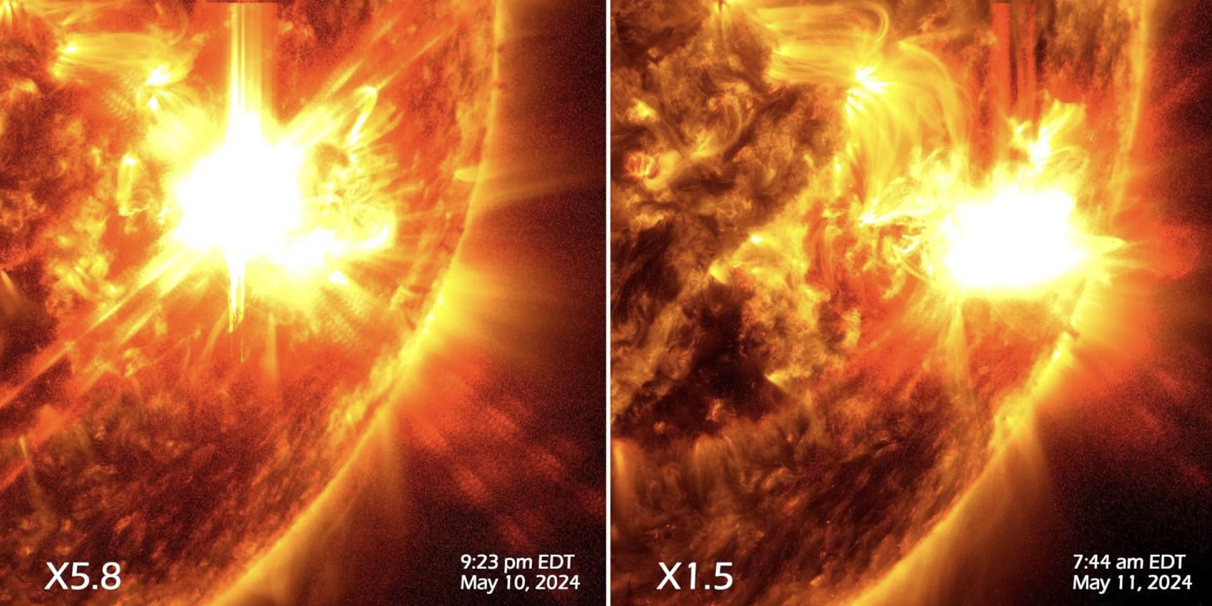
Image Credit: NASA/SDO: NASA's Solar Dynamics Observatory captured images of the two solar flares on May 10 and May 11, 2024.
Storm Consequences
The May 2024 space weather event had effects both on and off the Earth. It was the strongest geomagnetic event in over two decades, and caused widespread economic disruptions primarily through its impact on the Global Positioning System (GPS) and satellite communication networks. A year later, studies suggest that the agricultural sector had been the critical infrastructure experiencing the largest affects from the Gannon/Mother’s Day Storm.
Aviation & Travel
In the air, the threat of higher radiation exposure due to increased radiation levels at high altitudes, as well as widespread communication and navigation losses, forced trans-Atlantic flights to change their routes.
Although exact global revenue losses for the airline industry are difficult to quantify, measurable economic impact on aviation were detected. Researchers estimate that rerouting high-latitude transatlantic flights to avoid communication and navigation outages resulted in economic losses of approximately 8.582 USD per flight. These financial losses were driven by several factors, rather than a single massive drop in revenue: Planes were forced to take lower-latitude routes to maintain high-frequency radio and satellite navigation. These reroutes and detours required higher fuel consumptions. The detours increased average flight distances by approximately 5.2% and cruise-phase fuel consumption by approximately 5.1%. Airborne times rose by approximately 1.5%, with average departure and arrival delays increasing by approximately 15 minutes per flight.
Infrastructure & Telecommunications
In orbit, the expansion of Earth’s atmosphere increased drag on thousands of satellites. The NASA satellites ICESat-2, for example, lost altitude and entered “safe mode”, while the Colorado Inner Radiation Belt Experiment (CIRBE) CubeSat deorbited prematurely five months after the storm. Moreover, the ESA Sentinel mission required more power to maintain their orbits, and perform maneuvers to avoid collisions with space debris. While outright satellite hardware destruction was largely avoided, the sector experienced severe operational strains and significant financial impacts from the May 2024 geomagnetic storm.
As mentioned, unprecedented atmospheric expansion caused severe orbital drag. More than half of all active satellites in Low Earth Orbit (LEO), e.g., the Starlink Constellations, were forced to expend significant fuel on automated station-keeping adjustments, directly impacting the operational lifespans of commercial constellations. These huge maneuvering missions cost operators millions in reduced satellite lifespans and consumed valuable propellant. The bulk orbital shifts and drag uncertainty, additionally, made it nearly impossible to accurately track and calculate collision risks, which severely stressed the infrastructure for space traffic management.
Global Supply Chains
During the May 2024 space weather event, the global supply chains were also affected, as the geomagnetic storm degraded throughput by approximately 20% and doubled packet loss cases. The storm caused localized financial hits and temporary delays but did not trigger a systemic or widespread breakdown of global maritime, rail, or trucking logistics. However, the event served as a memorable test of global critical infrastructure preparedness, as it highlighted how heavily interconnected real-time operations from port logistics to intermodal transportation have become on space-based assets.
Studies of satellite network outages indicate that a severe space weather event threatening satellite communications alone increases the risk of billions of American dollars in global trade delays and supply chain inefficiencies.
Unusual Auroras
The geomagnetic storm also ignited auroras around the globe, including places where they are usually not experienced. However, this aurora was different, displaying a magenta color on the night sky in Japan, whereas they typically, displays colors like green, pink, violet, and red.
In a paper published in the journal ‘Scientific Reports’ by Ryuho Kataoka et al. (2024), the peculiar color was explained to be a result from a mix of red and blue auroras, produced by oxygen and nitrogen molecules lofted higher than usual by the heating of the geomagnetic storm, causing an expansion of the upper atmosphere.

Image Credit: Patrick Wayn: Auroras were seen across most of Australia during the 2024 Gannon solar storm.
Future Outlook
What did the Gannon/Mother’s Day Storm expose about society’s preparedness and capability to protect critical infrastructure?
The May 2024 space weather event spread auroras to unusually low latitudes, has been called the best-documented geomagnetic storm in space weather history, and produced the strongest geomagnetic storm recorded in over two decades. A year after the event, critical infrastructure operators and scientists had only just begun analyzing its data, trying to understand and revealing new lessons about the nature of geomagnetic storms, and how to enhance societal resilience from such events in the future. Today, this research is still ongoing.
This space weather event did not only highlight the space sector’s vulnerabilities to the huge influx of assets from Low Earth Orbit (LEO) and changing weather dependencies, but also the vulnerability and risks of significant cascading effects within critical infrastructure caused by space weather impact on a few critical infrastructure assets.
Although currently implemented mitigation measures were able to prevent catastrophic impact from the severe (G5) geomagnetic storm, major risk assessments, including models published by Lloyd’s of London and the Cambridge Centre for Risk Studies, cite that space weather events of this scale as catalysts for trillion American dollar macroeconomic risks to global energy infrastructure, supply chains, and banking systems. The May 2024 event revealed, that even with the currently implemented mitigation measures, significant economic losses cannot be fully avoided. This highlights the need for better collaborations, new innovative mitigation measures, and a stronger awareness and understanding of space weather impact on critical infrastructure.
*To learn more about the Gannon/Mother’s Day Storm, please read Hoplon’s articles: “C H A P T E R N ° 22 The May 2024 Space Weather Event” and “C H A P T E R N ° 23 May 2024 VS. The 2003 Halloween Storm”.*
Source
Wayne Griffin, Terry et al. (2025): “Impact of the Gannon Storm on corn production across the Midwestern USA”. AgManager.info, Kansas State Department of Agricultural Economics. https://www.agmanager.info/sites/default/files/pdf/Gannon_Corn_03-05-25.pdf
Hatfield, Miles et al. (2025): “What NASA is learning from the biggest geomagnetic storm in 20 years”. NASA. https://science.nasa.gov/science-research/heliophysics/what-nasa-is-learning-from-the-biggest-geomagnetic-storm-in-20-years/
Kumar Karan, Deepak et al. (2024): ”Gold observations of the merging of the Southern Crest of the equatorial ionization anomaly and aurora during the 10 and 11 May 2024 Mother’s Day super geomagnetic storm”. AGU. Vol. 51, Issue 15. DOI: https://doi.org/10.1029/2024GL110632
Werner, Debra (2025): “Solar flares in May 2024 revealed Earth’s vulnerability to space weather”. SPACENEWS. https://spacenews.com/solar-flares-in-may-2024-revealed-earths-vulnerability-to-space-weather/
Radasky, W.A. et al. (2010): “Impact of geomagnetic storms on EHV and UHV power grids”. ResearchGate. DOI: https://doi.org/10.1109/APEMC.2010.5475523
Transpower (2024): “Gannon geomagnetic storm: Event response summary and lessons learnt”. Transpower New Zealand. Version 1.0. https://static.transpower.co.nz/public/bulk-upload/documents/Event%204457%20-%20Gannon%20geomagnetic%20storm%20response%20summary%20and%20lessons%20learnt.pdf?VersionId=me4cehwLgGVV3f7V2ha0JafZhmikj1om
EVTALK (2025): “Transpower removes liens from service during severe solar storm (Updated Emergency over)”. EVs&BEYOND. https://evsandbeyond.co.nz/transpower-removes-lines-from-service-during-severe-solar-storm-updated-emergency-over/
NASA (2025): “Time period page for 2024-05-TP-02”. https://ccmc.gsfc.nasa.gov/TP/2024-05-TP-02/
SMC Spain (2025): “Massive power outage on the Iberian peninsula leaves millions without power supply”. https://sciencemediacentre.es/en/massive-power-outage-iberian-peninsula-leaves-millions-without-power-supply
Starion (2025): “When the space weather treat becomes reality”. STARION. https://www.stariongroup.eu/when-the-space-weather-threat-becomes-reality/
Arxiv (2026): “C-SWIM: A coupled space weather impact model for satellite fleet vulnerability and economic loss under a 1-in-100-year solar energetic particle event”. Arxiv. https://arxiv.org/html/2605.22576v1#bib
Universe Today/Science Daily (2026): "Low-Earth orbit is just 2.8 days from disaster." ScienceDaily. www.sciencedaily.com/releases/2026/01/260128075341.htm
Lloyd’s (n.d.): “Solar storm risk to the North American electric grid”. Lloyd’s and Atmospheric and Environmental Research (AER) Inc. https://assets.lloyds.com/assets/pdf-solar-storm-risk-to-the-north-american-electric-grid/1/pdf-Solar-Storm-Risk-to-the-North-American-Electric-Grid.pdf
Li, Jie et al. (2026): “Quantifying the impacts of the May 2024 geomagnetic storm on transatlantic aviation: rerouting, delays, and economic losses”. ResearchGate. AGU. DOI: https://doi.org/10.1029/2025SW004685
Grace, Im et al. (2024): “Quantifying the macroeconomics impacts of satellite failure from severe space weather on global supply chains”. DOI: 2024AGUFMNG33A2123I, website link: https://ui.adsabs.harvard.edu/abs/2024AGUFMNG33A2123I/abstract
Kataoka, Ryuho et al. (2024): “Extended magenta aurora as revealed by citizen science”. Scientific Reports. DOI: https://doi.org/10.1038/s41598-024-75184-9
