
C H A P T E R
N ° 57
The Water Sector
When we think of threats to the global water supply, we rarely look to the stars. However, as the water sector rapidly shifts toward advanced terrestrial digitization and automated controls, it opens the door to a new and complex cosmic variable: space weather. Far from being a niche concern exclusive to aerospace engineering, solar flares and geomagnetic storms present a direct, structural challenge to most of our critical public services.
In today’s article, we explore how geomagnetically induced currents (GICs) interact with Earth's liquid frontier — threatening long metal pipeline networks, disrupting critical supervisory control and data acquisition (SCADA) systems, and risking significant cascading failures through the electrical grid. For the modern water sector, recognizing these celestial realities is no longer optional; it is a fundamental requirement for systemic resilience, corporate governance, and disaster risk reduction (DRR).
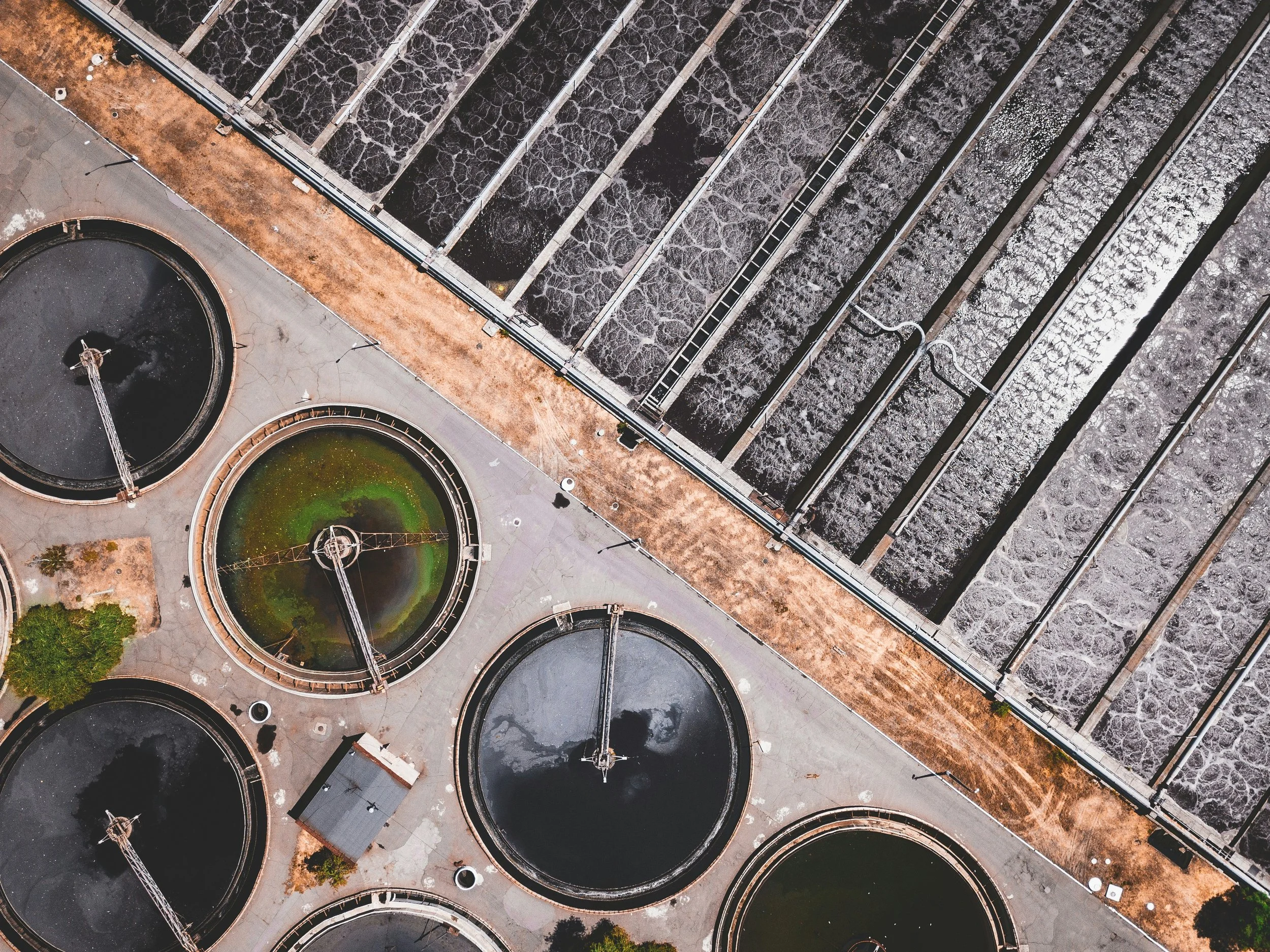
Image Credit: Ivan Bandura / Unsplash.com.
The Water Sector
The water sector is the entire socio-economic and environmental ecosystem responsible for managing water resources, providing safe drinking water, treating wastewater, and protecting communities from water-related hazards.
Unlike a traditional commercial industry that only focuses on selling a product, the water sector is defined by a “dual mandate”: it functions simultaneously as a critical public service (i.e., human right/environmental health) and a massive infrastructure industry (i.e., engineering/utilities).
The sector is generally defined across 4 core pillars:
1. The core value chain:
Water supply and utilities: the extraction, purification, and piped distribution of potable drinking water to residential, commercial, and industrial consumers.
Wastewater and sanitation: the collection of sewage and industrial effluent through network grids, followed by chemical, biological, or physical treatment before it is safely returned to nature.
Stormwater management: infrastructure such as dams, levies, and urban drainage designed to manage heavy rainfall, prevent flooding, and handle runoff.
2. Industry and support services:
Technology and innovation: companies developing smart water meters, desalinization technology, advanced filtration membranes, and artificial intelligence (AI) for leak detection.
Engineering and construction: the industry that builds and maintains treatment plants, reservoirs, pumping stations, and cross-country pipelines.
Chemicals and testing: providers of water-treatment chemicals – like chlorine or coagulants – and laboratory testing services to ensure safety standards.
3. Governance and natural resources:
Water resource management (WRM): government bodies and environmental agencies hat monitor aquifers, rivers, and lakes to ensure sustainable abstractions.
Regulation and policy: public entities that set water quality standards, mandate environmental compliance, and regulate the pricing tariffs that utilities can charge citizens.
4. Cross-sector dependencies:
The water sector is also fundamentally defined by its intersections with other macro-sectors.
The energy-water interdependency: the water sector requires vast amounts of energy to pump and treat water, while the energy sector requires vast amounts of water for cooling power plants and generating hydropower.
Agriculture: the single largest consumer of global water resources through irrigation is the agricultural sector.
Space Weather
“Space weather” refers to the dynamic and changing environmental conditions in the space surrounding Earth, driven entirely by the Sun. It is caused by solar activity, such as solar flares, coronal mass ejections (CMEs), and high-speed streams of solar wind (HSS). These solar events release massive bursts of radiation, intense magnetic fields, and highly charged atomic particles into the Solar System. When this solar material travels through space and collides with Earth, it interacts heavily with the planet's magnetic field and upper atmosphere. While often invisible, this interaction is the direct physical cause of the Northern and Southern Lights.
The Inevitable Current: Space Weather Interacting with the Water Sector
Most of the time, space weather particles do not directly strike water molecules on Earth’s surface, as the planet’s atmosphere and magnetic field blocks them. Instead, space weather interacts with the water sector through a chain reaction of physics, primarily driven by geomagnetic storms (i.e., a type of space weather event) and geomagnetically induced currents (GICs).
” Geomagnetically induced currents (GICs) are electrical currents that flow on and within the Earth's surface and through man-made, long-conductor infrastructure due to rapid fluctuations in the Earth's magnetic field.”
However, while the Earth’s magnetic field and atmosphere deflect or absorb most particles from solar storms, severe and extreme space weather can directly penetrate these planetary shielding mechanisms and interact with Earth’s land, oceans, and – in this case - water systems.
During hyper-intense solar proton events, high-energy particles can smash into the atmosphere and create a cascade of secondary radiation that ‘rains’ directly down to the Earth’s surface and its oceans, consequently creating ground level enhancements. Simultaneously, these severe events temporarily degrade the ozone layer, allowing harmful ultraviolet radiation to reach landmasses and aquatic ecosystems. It is, however, no hazard to people walking the surface of Earth.
When these particle streams crash into the planet, they disrupt Earth’s magnetic field. This creates a chain reaction of physics that drives powerful geomagnetically induced currents (GICs) directly through the highly conductive saltwater of the oceans, underground geology, and man-made systems.
Because the contemporary water sector relies heavily on long metal pipeline infrastructure, automated supervisory control and data acquisition (SCADA) controls, and a continuous electrical power grid, these severe and extreme space weather interactions can cause profound and cascading operation disruptions across the entire water cycle. It is worth noticing, that event milder space weather events are capable of affecting similar systems through cascading effects, due to the water sectors dependency on other critical infrastructure more vulnerable to direct space weather impact.
Cascading Operational Failures: Space Weather Vulnerabilities in the Water Sector
Space weather affects the infrastructure and technologies of the water sector in the following ways:
Accelerated corrosion in metal water mains (i.e., pipeline degradation)
Disruption of smart water meters and supervisory control and data acquisition (SCADA) systems
Disruption of remote sensing for water resource management
Cascading failures through power grid blackouts
To precent massive steel or iron water pipelines from rusting underground, utilities utilize electronic cathodic protection systems, which run a low-voltage DC electrical current through the pipe to neutralize oxidation. When a coronal mass ejection (CME) hits Earth, it interacts with the planet’s magnetic field (shakes it), inducing rapid, fluctuating electrical currents known as “telluric currents” directly into the ground and the long metal pipelines. These solar-induced currents cause massive voltage swings that overwhelm and temporarily knock out cathodic protection rectifiers. Over time, or during and extreme space weather event, being pushed into an “unprotected” voltage state significantly accelerates the corrosion and cracking of water mains.
Modern water distribution networks, additionally, rely heavily on supervisory control and data acquisition (SCADA) systems, automated sensors, and cellular networks to monitor water flow, pressure, and chemical levels remotely. Extreme space weather events can trigger solar radio bursts or ionospheric disruptions that interfere with high-frequency radio and satellite communication channels. Geomagnetically induced currents (GICs) traveling through ground circuitry can trick flow meters into reporting false pipeline flow rate data or trigger out-of-range protection alarms. Additionally, if communication channels are disrupted, operators lose real-time visibility over critical valve controls, chemical dosing pumps, and leak detection networks.
Furthermore, environmental agencies use satellite-based data to monitor large-scale water health, such as tracking drought levels, mapping reservoir volume, and assessing coastal water quality or toxic algae blooms. During solar radiation storms, high-energy protons can hit orbiting satellites, blinding optical sensors or cause single-event upsets (SEUs) in their computers. This degrades the accuracy of the satellite models that water resource managers depend on to calculate seasonal snowmelt, manage dam outflows, and track watershed contamination.
However, the single greatest threat space weather poses to the water sector is a cascading structural failure through the electrical power grid. The documented evidence linking space weather to water infrastructure failures come from post-incident utility reports, engineering case studies on pipeline corrosion, and government infrastructure interdependency reviews. Because the water sector is deeply tied to the electrical grid, major space weather events have historically caused documented, cascading failures in water delivery. High-voltage electricity transmission lines act as a massive antenna for geomagnetically induced currents (GICs). When these currents surge into electrical transformers, they can cause overheating, voltage instability, and permanent damage. As documented in severe historical solar storms like the 1989 Hydro-Québec blackout, a collapsed grid immediately cuts power to municipal water services. Without electricity, water utilities cannot run the high-powered intake motors, pressurized distribution pumps, and wastewater aeration tanks. This stops the flow of fresh drinking water, cuts fire hydrant pressure, and stops sewage processing, returning a modern city to a pre-industrial sanitary state within hours if backup generators fail.
Due to these vulnerabilities, major modern national infrastructure reviews explicitly categorize the water sector as a high-risk critical national infrastructure (CNI) dependency vulnerable to the cascading impacts of space weather.
Securing the Liquid Frontier Against Celestial Realities
The intersection of advanced terrestrial digitization and severe space weather represents an immediate, structural challenge for the global water sector. As municipal utilities and private engineering firms increasingly anchor their operations in automated supervisory control and data acquisition (SCADA) controls, expand their long metal pipeline networks, and rely on continuous electrical power grid stability, the sector's systemic risk profile fundamentally shifts. Space weather can no longer be viewed as a peripheral hazard confined to aerospace engineering or satellite operations. Instead, it must be recognized as an active operational variable that directly impacts public health, corporate governance, and regional disaster risk reduction (DRR).
Addressing these complex vulnerabilities requires a proactive shift from reactive management to systemic resilience. For the water sector, this demands a coordinated, multi-layered approach to mitigation. Recognizing space weather as an active operational reality allows the water sector to safeguard critical infrastructure and maintain water cycle stability.
Source
Cybersecurity and Infrastructure Security Agency (CISA) (2024) Space Weather - CISA. Washington, D.C.: U.S. Department of Homeland Security. Available at: https://www.cisa.gov/topics/risk-management/space-systems/space-weather (Accessed: 6 October 2026).
Gabor, G. and Tanyi, G. (2023) ‘Space Weather Effects on Critical Infrastructure’, arXiv preprint, arXiv:2306.16380. Available at: https://arxiv.org/abs/2306.16380 (Accessed: 6 October 2026).
Ingham, M., Richardson, W. P., Beggan, C. D. and Rodger, C. J. (2025) ‘Observed Effects of the May 2024 Gannon Storm on the New Zealand Gas Pipeline Network—Toward Predicting the Effects of an Extreme Storm’, Space Weather, 23(2), e2024SW004258. doi: 10.1029/2024SW004258.
Joint Research Centre (JRC) (2016) Space Weather & Critical Infrastructures: Findings and Outlook. EUR 28237 EN. Luxembourg: Publications Office of the European Union. doi: 10.2788/441753.
Starion Group (2025) Starion publishes SWIMMR report on space weather impacts on UK critical infrastructures. Brussels: Starion Group. Available at: https://www.stariongroup.eu/starion-publishes-swimmr-report-on-space-weather-impacts-on-uk-critical-infrastructures/ (Accessed: 6 October 2026).
Trichtchenko, L. and Boteler, D. H. (2023) ‘Evaluation of telluric-associated corrosion on buried pipelines’, Journal of Atmospheric and Solar-Terrestrial Physics, 248, p. 106082. doi: 10.1016/j.jastp.2023.106082.
