
C H A P T E R
N ° 43
Autonomous Maritime Vessels (Part 2)
In recent years, the interest for fully autonomous maritime vessels have increased. The sector is investing in automation to address critical operational, safety, and environmental challenges, aiming to transform shipping into a more efficient, sustainable, and safer industry. Moreover, automation technologies like Artificial Intelligence (AI), Internet of Things (IoT), and robotics are being implemented to optimize everything from vessel navigation to port cargo handling due to the need to manage rising global trade volumes. However, the understanding of weather interferences from space on autonomous technology is still sparse.
The maritime sector is considered a critical infrastructure because it is the backbone of global trade, carrying over approximately 80% of international goods, and is essential for energy, food, and communication security. It includes vital and vulnerable assets such as ports, shipping lanes, and undersea cables, making its protection essential for national security, economic stability, and defense. Yet, critical infrastructure is characterized by a complex “system of systems” design, wherein the operation of one sector depends heavily on the functionality of one or more other sectors, consequently creating a complex and highly vulnerable net of infrastructure. The maritime sector exemplifies this interdependence clearly.
Space weather resilience is critical for the maritime sector, as modern shipping is heavily reliant on satellite-based technology, making it vulnerable to solar events. As shipping embraces "e-navigation" and autonomous vessels, the ability to withstand disruptions to – for example - Global Navigation Satellite Systems (GNSS) is essential for safety and operational continuity. Space weather resilience is a crucial element of modern maritime risk management, ensuring that ships can continue to operate safely, efficiently, and with minimal interruption during periods of intense solar activity.
“ E-navigation is the International Maritime Organization’s (IMO) strategy to harmonize, collect, exchange, and analyze maritime information on board and ashore through electronic means. It aims to enhance safety, security, and environmental protection by digitizing maritime services, reducing administrative burdens, and improving situational awareness for mariners. “
In today’s article, we will, therefore, look closer at the relation between space weather and autonomous maritime vessels. Today’s article will be the second part, and thus the last, of two articles focused on the relation between space weather and automation in the maritime sector. Combined the articles will explore the concept of autonomous maritime vessels and the different classification degrees. Additionally, they will examine how space weather impacts the technology onboard autonomous maritime vessels, and subsequently consider the potential consequences these effects may have on both safety and overall operational efficiency at sea.
In this article; C H A P T E R N ° 43 Autonomous Maritime Vessels (Part 2), we will look closer at autonomous maritime vessel technological systems and space weather.
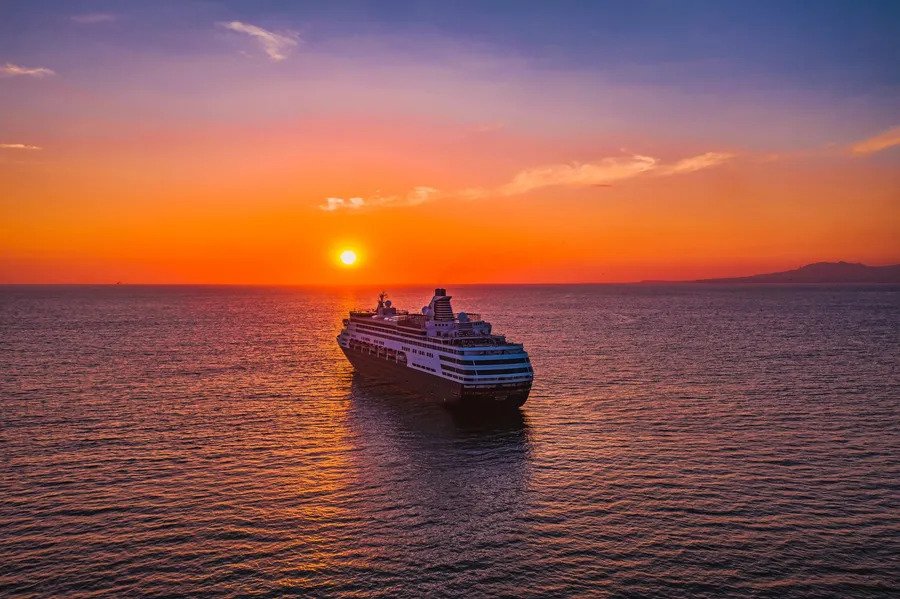
Image Credit: Kajo820/Wallpapers.com.
Autonomous maritime vessels technological systems and space weather
Key components for maritime safety
Safe maritime operations rely on a combination of navigation technology, lifesaving appliances, and robust firefighting systems. In short, the key components for maritime safety are:
Navigation & Communication: the Global Positioning System (GPS), chartplotters, Radio Detection And Ranging (RADAR), Automatic Identification System (AIS) transponders, Electronic Chart Display and Information System (ECDIS)), Echosounders, and Navigational Telex (NAVTEX)/Very-High Frequency (VHF) radios for situational awareness.
Life-Saving & Survival: Lifeboats, inflatable life rafts, immersion suits, Emergency Position Indicating Radio Beacons (EPIRBs)), and Search and Rescue Transponders (SART).
Fire & Damage Control: Fire suppression systems (CO2, foam, powder), smoke/gas detectors, and emergency shutdown systems.
Structural & Technical Safety: Watertight doors, robust deck equipment, load monitoring sensors, and explosion-proof (ATEX) equipment.
Crew & Operational Procedures: Trained personnel (Standards of Training, Certification, and Watchkeeping (STCW) compliant), regularly practiced emergency drills (Man Overboard (MOB), fire), safety management systems, and Personal Protective Equipment (PPE).
Environmental Monitoring: Weather monitoring systems and stability tracking, using integrated sensor networks, automated data logging systems, and, in some cases, remote sensing technologies.
“ Navigational Telex (NAVTEX) is an international, automated direct-printing service for delivering coastal maritime safety information (MSI)—including navigational/meteorological warnings and urgent forecasts—directly to ships. “
“ The Electronic Chart Display and Information System (ECDIS) is an International Maritime Organisation-compliant, computer-based navigation system that acts as an advanced alternative to paper charts, improving maritime safety and efficiency. It integrates real-time GPS data with Electronic Navigational Charts (ENCs), radar, and AIS, enabling automated route planning, monitoring, and collision avoidance. ”
These systems ensure compliance with regulations to protect personnel, cargo, and the vessel itself.
Autonomous vessels
As showcased throughout this article, regardless of maritime vessels being partially or fully automated, their functionality and sufficiency more or less depend on the well-functioning of satellites (i.e., critical space infrastructure) and the energy sector (i.e., critical terrestrial infrastructure). Furthermore, it, additionally, implies a dependency on the conditions of on the Sun and the Earth’s atmosphere.
The new goal of the maritime sector is to provide fully autonomous vessels. With this goal, the foundational elements of fully automated vessel systems are machine learning (ML) and artificial intelligence (AI). Yet, these depend on and are enabled by satellites and the energy sector. Machine learning (ML) is the foundational technology enabling autonomy in maritime vessels, moving them from simple automation to independent, intelligent decision-making. In autonomous maritime vessels, machine learning is primarily used to enhance situational awareness, ensure safety through collision avoidance, optimize performance for fuel efficiency, and perform predictive maintenance. It relies on the data transmission and exchange capabilities enabled by 5G networks. Machine learning (ML) is fundamentally enabled and accelerated by a system that relies on the energy sector to transfer data from cell towers, small cells on utility poles, and fiber-optic backhaul, and the Global Navigation Satellite System (GNSS) for precise timing, which is crucial for coordinating user devices. 5G networks are entirely dependent on a consistent and high-capacity electrical power supply to operate its base stations and data centers.
Artificial intelligence (AI) in autonomous maritime vessels is used to replace or augment human decision-making, enabling vessels to navigate, operate, and maintain themselves with little or no human intervention. It uses things like connected vessel technology (AIS, satellites, VHF Data Exchange System (VDES), and Internet of Things (IoT)) to communicate with other vessels and infrastructure in order to detect close-by objects and map its surrounding environment. It is used for: Navigation and collision avoidance by analyzing data from radar, Automatic Identification System (AIS), and cameras to detect, classify, and track objects (e.g., ships, buoys, small boats) in real-time; Route optimization and fuel efficiency by analyzing weather forecasts, sea conditions, and vessel performance to recommend the most efficient routes; Predictive maintenance by monitoring sensor data from engines, pumps, and generators to detect early signs of wear or failure; Port operations and logistics by optimizing port traffic, predicting vessel arrival times and managing berthing schedules to minimize congestion, and; Autonomous systems. Artificial intelligence (AI) in autonomous maritime vessels, thus, acts as the "brain" of the vessel, analyzing vast amounts of data from sensors in real-time to enhance safety, efficiency, and sustainability.
Autonomous technology can function without traditional, high-power, on-board digital computers. However, currently, high-performance computing is generally required for advanced, real-time autonomous systems. The powerful computer systems process the collected data, wherefrom discissions about maritime vessel operations are made, continuously adjusting steering, cruising speed, etc. This is all done through a continuous communication between the vessel’s sensors, constantly collecting information about its surroundings and sending it back to its computer system, wherefrom it is processed and decisions are made. This computer system is operated by artificial intelligence (AI) that continuously depend and runs on services provided by satellites and the energy sector. Furthermore, the entire vessel system depends on the 5G network for quick response and communication between the vessel’ systems. Thus, the vessel depends on telecommunication satellite services and the Global Navigation Satellite System (GNSS).
Currently when discussing the challenges of creating autonomous maritime vessels, discussions entail challenges in cybersecurity, navigating complex regulatory frameworks, ensuring artificial intelligence (AI) reliability in collision avoidance, and overcoming high upfront investment costs. Other key hurdles include managing emergency situations without crew, integrating with manned ships in mixed traffic, and adapting traditional insurance models to new risk profiles.
Space weather and autonomous technological systems
As mentioned further above, some of the core technologies enabling a fully and partially autonomous maritime vessel are sensors, artificial intelligence, machine learning, powerful computers, and communication systems. All of this rely on satellites, the energy sector, and the Earth’s atmospheric conditions. When looking at how space weather affects the technology used onboard autonomous maritime vessels, something to look closer at should, therefore, be on the relation between space weather and the energy sector, satellites, and the Earth’s atmosphere.
Space weather affects the energy sector in certain ways that can increase the risk of momentarily power failures and even cause complete blackouts. Likewise, this natural hazard interacts with satellites, the near-Earth space environment, and the Earth’s atmosphere in such a way, that it can affect the way in which data from the satellites are transferred to the receivers on the ground. An issue caused during the data transferring from the satellite to a ground-receiver can, for example, cause ‘noise’ in the data, making it unreliable, or interfere in such ways that the data never reaches the receivers. As the information sent or received cannot be fully trusted, this increases vulnerability and the risk of safety and/or operational issues.
In the case of an autonomous maritime vessel, space weather poses critical risks by disrupting satellite navigation (Global Navigation Satellite System (GNSS)/Global Positioning System (GPS)), satellite communications (SATCOM), and electronic sensor systems. Because autonomous maritime vessels heavily rely on these technologies for situational awareness and remote control, solar events can lead to navigation failures, communication blackouts, or dangerous, uncrewed scenarios.
Key impacts of space weather on autonomous maritime vessels:
1. Navigation & Positioning Failure: Solar activity can cause significant errors or total loss of Global Navigation Satellite System (GNSS) signals, essential for automated navigation, potentially causing ships to lose track of their precise location.
2. Communication Loss: Geomagnetic disturbances can disrupt SATCOM (e.g., Iridium, Starlink) needed for remote monitoring by shore-based control centers.
3. Sensor Interference: Sensitive radar and camera systems can be degraded by electromagnetic interference caused by space weather, hindering artificial intelligence (AI)-driven obstacle detection.
4. Increased Risks: While no major accidents are directly attributed yet, a sudden loss of communication with the autonomous vessel or guidance could create severe risks for unmanned vessels, increasing safety issues for its surroundings.
The risk of incorrect information, a temporary blackout, or interferences of any of the above-mentioned increases safety risks for their surroundings - and crew and passengers in a case of a partially autonomous vessel. The interaction and potential effects of space weather on autonomous maritime vessels, therefore, must be taken into account when creating and implementing such advanced inventions. The current and future changes in the maritime sector’s way of designing and constructing vessels will determine the overall level of risk and vulnerabilities posed on future maritime vessels when discussing space weather impact.
Source
Fiori, Robyn (2022): “Development of space weather services to inform maritime users of space weather events affecting high frequency radio communication”. 44th COSPAR Scientific Assembly. Held 16-24 July, 2022. Volume 44. Online at https://www.cosparathens2022.org/. Abstract PSW.1-0001-22. Pp. 3435.
Grant, Alan; Shaw, George (2012): “The effect of space weather on maritime aids-to-navigation service provision”. Annual of Navigation. Vol. 19(1). DOI: https://doi.org/10.2478/v10367-012-0005-9?urlappend=%3Futm_source%3Dresearchgate
Xue Dabin et al. (2024): “Space weather effects on transportation systems: A review of current understanding and future outlook”. Advancing Earth and Space Science (AGU). Volume 22, Issue 12. DOI: https://doi.org/10.1029/2024SW004055
Ishii, Mamoru et al. (2024): “Space weather impact on radio communication and navigation”. ELSEVIER. Advances in Space Research. DOI: https://doi.org/10.1016/j.asr.2024.01.043
NOAA (n.d.): “HF Radio communication”. https://www.swpc.noaa.gov/impacts/hf-radio-communications#:~:text=Space%20weather%20can%20impact%20HF%20radio%20communication,enhanced%20D%2Dlayer%20that%20blocks%20HF%20radio%20communication.
Danish Maritime Authority (n.d.): “AIS data”. https://www.dma.dk/safety-at-sea/navigational-information/ais-data
Hansen, Nicholas (2023): “Situational Awareness for autonomous marine vessels”. Technical University of Denmark (DTU). https://backend.orbit.dtu.dk/ws/portalfiles/portal/338331238/PhD_thesis_260_sider_-_76_farvede.pdf
WindWard (n.d.): “Automatic Identification Systems (AIS)”. https://windward.ai/glossary/what-is-automatic-identification-systems-ais/
SKYFI (n.d.): “Vessel tracking: keeping ships on course with modern technology”. https://skyfi.com/en/blog/vessel-tracking-keeping-ships
Maritime Fairtrade (2024): “Navigating safety: importance of maritime vessel tracking systems”. https://maritimefairtrade.org/navigating-safety-importance-of-marine-vessel-tracking-systems/
Maljković, Mislav et al. (2022): ”Situational Awareness from the master point of view and importance of factors that influence it”. ResearchGate. Conference ICTS 2022. https://www.researchgate.net/publication/361735423_SITUATIONAL_AWARENES_FROM_THE_MASTER_POINT_OF_VIEW_AND_IMPORTANCE_OF_FACTORS_THAT_INFLUENCE_IT
Hansen, Nicholas (2023): “Situational Awareness for autonomous marine vessels”. Technical University of Denmark (DTU). https://backend.orbit.dtu.dk/ws/portalfiles/portal/338331238/PhD_thesis_260_sider_-_76_farvede.pdf
European Maritime Safety Agency (EMSA) (n.d.): “Maritime autonomous surface ships (MASS)”.https://www.emsa.europa.eu/mass.html
International Maritime Organization (n.d.): “Autonomous shipping”. https://www.imo.org/en/mediacentre/hottopics/pages/autonomous-shipping.aspx
Shkuro, Sophia (2023): “What is autonomous shipping?”. SEARATES by DP World. https://www.searates.com/blog/post/what-is-autonomous-shipping
Jan Rødseth, Ørnulf et al. (2017): ”Difinitions for autonomous merchant ships”. Researchgate. DOI: https://doi.org/10.13140/RG.2.2.22209.17760
United Nations Economic Commission for Europe (UNECE) (2025): “Working party on inland water transport”. https://unece.org/sites/default/files/2025-10/ECE-TRANS-SC.3-2025-inf.doc.4E.pdf
International Maritime Organization (n.d.): “Maritime safety”. https://www.imo.org/en/ourwork/safety/pages/default.aspx
