
C H A P T E R
N ° 48
The Gannon / Mother’s Day Storm: Economic Impact (Part 1)
On May 10, 2024, the first severe (category; G5, on the NOAA space weather scales and benchmarks) geomagnetic storm in over two decades hit Earth. Since then, a lot of research have been done looking into the overall event and its impact.
In today’s article, we will, therefore, revisit the May 2024 space weather event - also known as the Gannon Storm and the Mother’s Day Storm - and look closer into its economic impact. This article will be the first of two articles focused on the May 2024 event and its impact. We will start with a discussion on the impact of the event on the near-Earth space environment, and the Earth’s atmosphere and its magnetosphere, and how these had cascading effects on critical space and ground-based infrastructure. Following this, we will explore the economic impact within different critical infrastructures. Lastly, we will provide a future outlook, discussing what the Gannon/Mother’s Day Storm exposed about society’s capability to protect critical infrastructure.
In this article; C H A P T E R N ° 48 The 2024 Gannon/Mother’s Day Storm: Economic Impact (Part 1), we will start by looking closer at the impact of the Gannon/Mother’s Day Storm on the near-Earth space environment, and the Earth’s atmosphere and its magnetosphere, and how these had cascading effects on the energy sector and the agricultural sector.
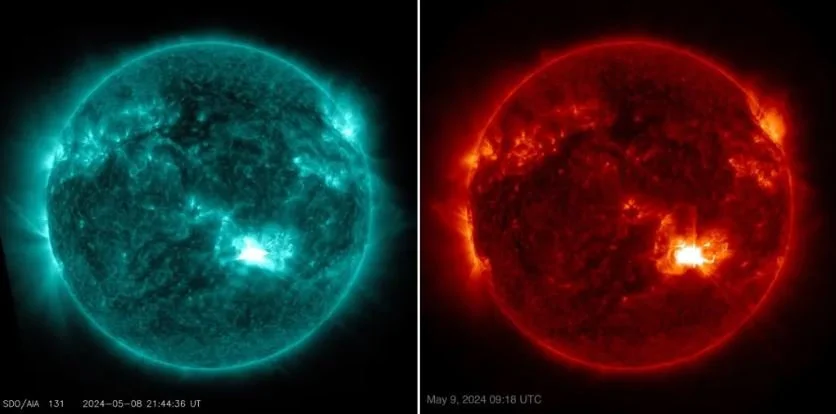
Image Credit: NASA/SDO: NASA's Solar Dynamics Observatory captured images of the solar flares on May 8, 2024 (left), and May 9, 2024 (right).
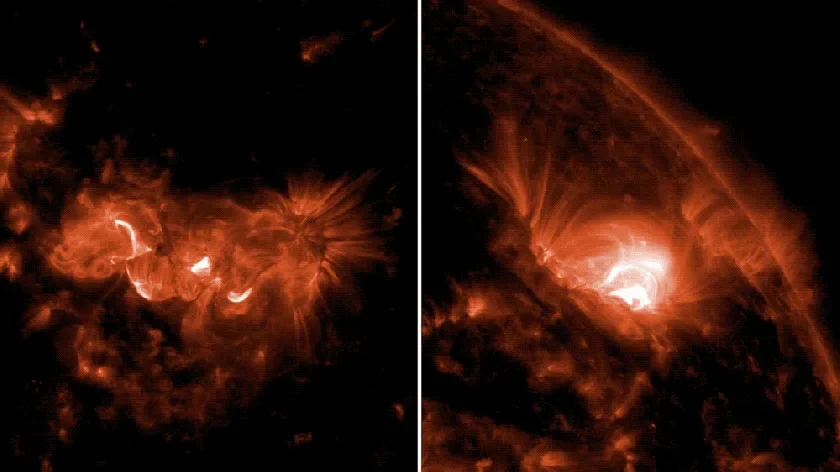
Image Credit: NASA/SDO: Image showing two strong solar flares, occurring on 8 May (left) and on 9 May (right).
The Earth’s atmosphere
During the 2024 space weather event, the Earth’s upper atmospheric layer called the ‘thermosphere’ heated to unusually high temperatures. At approximately 160 km (100 miles) altitude, the temperature typically peaks at 1.200 degrees Fahrenheit, however, during the space weather event it surpassed 2.100 degrees Fahrenheit. Data provided by the NASA’s ‘Global-scale Observations of the Limb and Disk (GOLD)’ mission additionally showed that the Earth’s atmosphere expanded from the heat, leading to the creation of strong wind that forced heavy nitrogen particles higher. Moreover, the geomagnetic storm changed the structure of the Earth’s atmospheric layer called the ‘ionosphere’. Normally, a dense zone of the ionosphere covers the equator at night, but during the storm it started bending towards the South Pole, consequently causing a temporary gap near the Earth’s equator.
The Earth’s magnetosphere
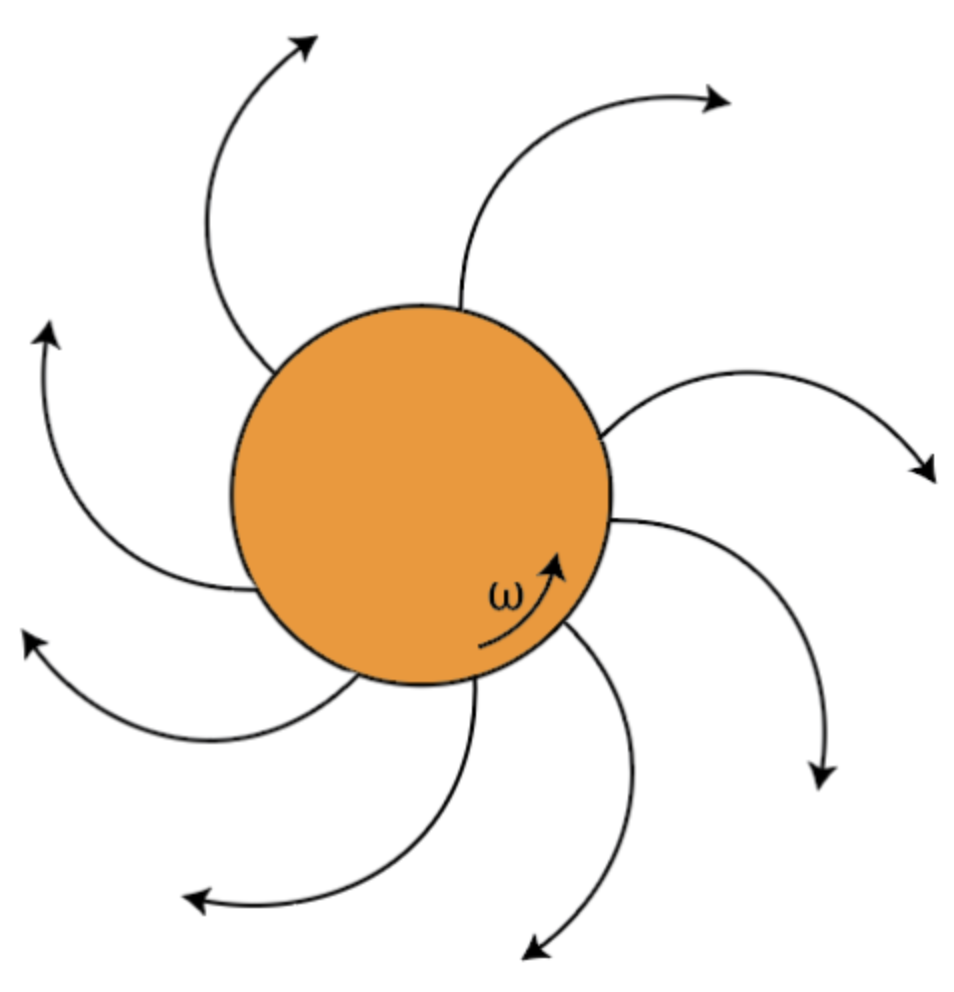
Image Credit: HAPLESS PIGEON: Illustration of parker spiral.
The Earth’s magnetic field (magnetosphere), which is the planets natural shielding mechanism against e.g., space weather, was also affected by the space weather event. Satellite data from NASA missions like the Magnetospheric Multiscale mission and THEMIS-ARTEMIS showed curling waves of particles and Parker Spirals (i.e., rolled-up magnetic fields) along the edge of the Coronal Mass Ejections (CMEs) causing the geomagnetic storm. This was important data, as space weather forecasts rely on them to predict when solar storms and radiation will hit Earth. Solar energetic particles and cosmic rays travel along the spiral tracks rather than taking a straight path. The waves from the particles of the Coronal Mass Ejections (CMEs) during the Gannon/Mother’s Day Storm were sized in such a way, that they were perfectly sized to add extra magnetic energy and mass into the magnetosphere of Earth upon impact, creating the largest electrical current observed in the Earth’s magnetosphere in 20 years.
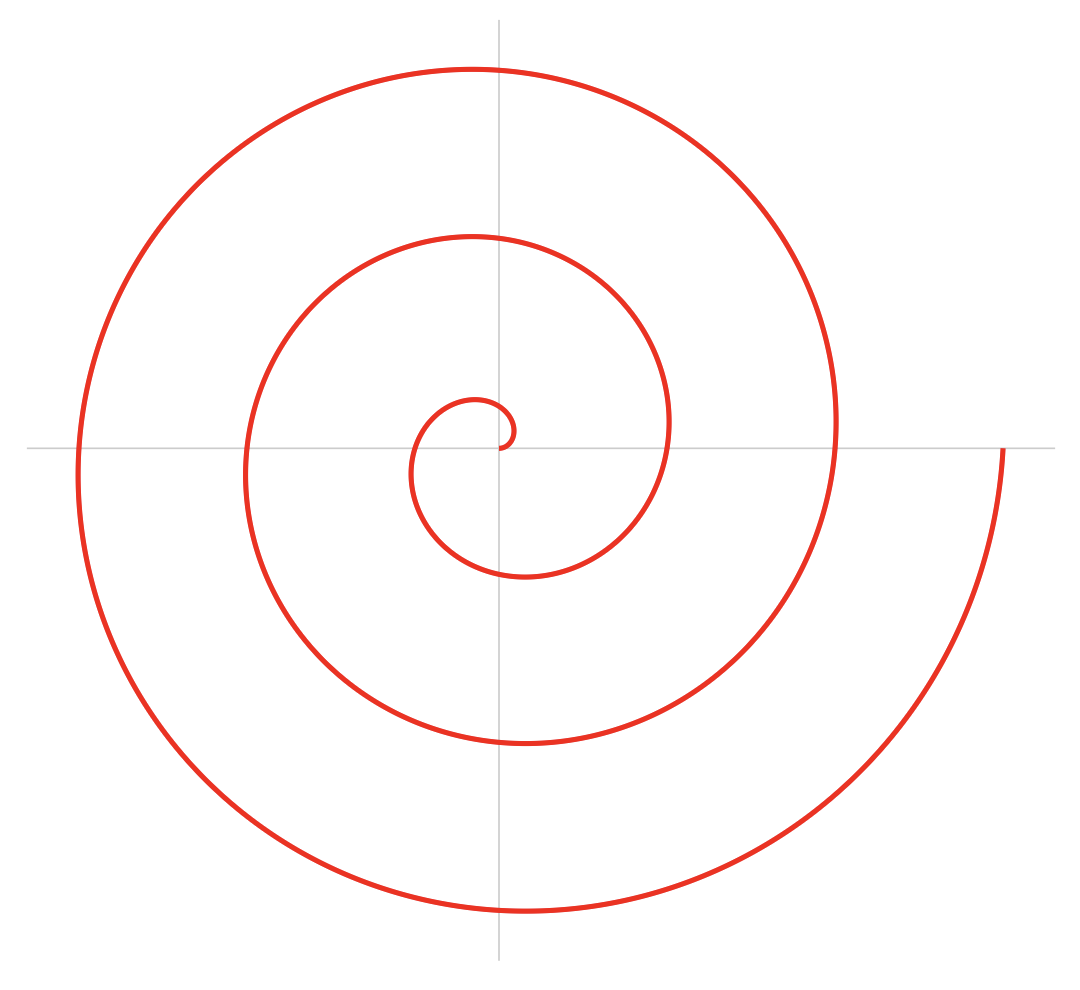
Image Credit: Wikipedia: Illustration of Archimedean spiral.
“ A Parker spiral describes the shape of the Sun’s magnetic field extending through the solar system. As the Sun rotates, it drags the outward-flowing solar wind and its embedded magnetic field lines along with it, twisting them into an expanding Archimedean spiral, which is a curve that winds outward from a central point at a constant rate. “
When solar activity reaches a certain level of intensity it can burst out into the solar system. The burst contains plasma, which is superheated ionized gas (the fourth state of matter), that are magnetically and electrically charged. This gives these events the ability to interact with the Earth’s magnetic field and technology. The Earth’s magnetic field can usually deflect the everyday solar wind streams coming from the Sun, however, when a strong Coronal Mass Ejection collides with the planet, the magnetosphere becomes highly compressed and turbulent. The full impact of a Coronal Mass Ejection depends on several parameters, such as its strength, the direction of the magnetic field poles, and whether it is Earth-directed.
The incoming highly energized particles additionally created two new temporary radiation belts of energetic particles within the magnetosphere, more specifically, they formed between the Van Allen radiation belts which permanently surrounds Earth. The discovery of the creation of new radiation belts within the Van Allen belts was important for research on spacecraft and astronaut safety, as the high-energy electrons and protons in the belts can endanger both.
Storm Consequences
The May 2024 space weather event had effects both on and off the Earth. It was the strongest geomagnetic event in over two decades, and caused widespread economic disruptions primarily through its impact on the Global Positioning System (GPS) and satellite communication networks. A year later, studies suggest that the agricultural sector had been the critical infrastructure experiencing the largest affects from the Gannon/Mother’s Day Storm.
Energy Sector and Power Grid Systems
The Gannon/Mother’s Day Storm geomagnetic storm caused significant economic costs within power grid infrastructure by inducing Geomagnetically Induced Currents (GIC) that overheated transformers and tripped high-voltage transmission lines. When high-voltage lines "trip," protective relays detect electrical faults (e.g., from lightning strikes, fallen trees, or equipment failure) and instruct circuit breakers to open. This interrupts the flow of electricity to prevent catastrophic equipment damage, fires, and dangerous voltage spikes on the grid. These effects forced grid operators, such as ‘Transpower’ in New Zealand, to declare Grid Emergencies and temporarily remove circuits from service to protect equipment from grid failure and reduce Geomagnetically Induced Currents (GICs) impacts. Currents were observed as high as 113 Amps, which is considered a highly significant action-triggering level for operators of the New Zealand power grid. However, active mitigation plans prevented adverse impacts. In North America, grid equipment owners reported isolated effects on generators and transmission equipment, whereas in Europe, monitoring data revealed rapid magnetic variations and induced electric fields throughout the Italian peninsula, which generated currents potentially hazardous to critical infrastructure. Overall, while operators experienced voltage control warnings and had to reconfigure assets, advance warnings, established mitigation measures, and the fluctuating nature of the storm’s currents allowed grids to remain largely stable, avoiding prolonged blackouts that could have led to trillion-dollar infrastructure damages. However, the cascading economic impacts were extensive.
Agriculture and Precision Farming
The most severe economic impact occurred in the Midwestern United States during the critical spring planting season. The Gannon/Mother’s Day Storm caused some high-voltage lines to trip, transformers to overheat, and Global Positioning System (GPS) guided tractors to steer off-course in the Midwestern U.S., further disrupting planting that had already been delayed due to heavy rains that spring.
Modern farming equipment relies heavily on the Global Navigation Satellite System (GNSS)/the Global Positioning System (GPS) technology with centimeter-level accuracy for automated steering and seed distribution. However, during the Gannon/Mother’s Day geomagnetic storm, the signals of the satellites providing services enabling those capabilities got severely degraded, forcing tractors off course or rendering them completely inoperable. The delayed planting forced farmers to delay planting into later weeks, directly impacting crop yields and total revenues. According to Kansas State University economists’ calculations, the Midwestern corn industry suffered between 500 million USD to 1.7 billion USD in foregone revenue, with individual affected farmers losing and average of 17.000-17.700 USD due to stalled or inaccurate planting caused by the May 2024 space weather event. The most direct and quantified economic losses did, thus, not come from power outages, but from grid-reliant Global Positioning System (GPS) systems.
To be continued …
* To learn more about the Gannon/Mother’s Day Storm, please read Hoplon’s article: C H A P T E R N ° 20 The May 2024 Space Weather Event.*
Source
Wayne Griffin, Terry et al. (2025): “Impact of the Gannon Storm on corn production across the Midwestern USA”. AgManager.info, Kansas State Department of Agricultural Economics. https://www.agmanager.info/sites/default/files/pdf/Gannon_Corn_03-05-25.pdf
Hatfield, Miles et al. (2025): “What NASA is learning from the biggest geomagnetic storm in 20 years”. NASA. https://science.nasa.gov/science-research/heliophysics/what-nasa-is-learning-from-the-biggest-geomagnetic-storm-in-20-years/
Kumar Karan, Deepak et al. (2024): ”Gold observations of the merging of the Southern Crest of the equatorial ionization anomaly and aurora during the 10 and 11 May 2024 Mother’s Day super geomagnetic storm”. AGU. Vol. 51, Issue 15. DOI: https://doi.org/10.1029/2024GL110632
Werner, Debra (2025): “Solar flares in May 2024 revealed Earth’s vulnerability to space weather”. SPACENEWS. https://spacenews.com/solar-flares-in-may-2024-revealed-earths-vulnerability-to-space-weather/
Radasky, W.A. et al. (2010): “Impact of geomagnetic storms on EHV and UHV power grids”. ResearchGate. DOI: https://doi.org/10.1109/APEMC.2010.5475523
Transpower (2024): “Gannon geomagnetic storm: Event response summary and lessons learnt”. Transpower New Zealand. Version 1.0. https://static.transpower.co.nz/public/bulk-upload/documents/Event%204457%20-%20Gannon%20geomagnetic%20storm%20response%20summary%20and%20lessons%20learnt.pdf?VersionId=me4cehwLgGVV3f7V2ha0JafZhmikj1om
EVTALK (2025): “Transpower removes liens from service during severe solar storm (Updated Emergency over)”. EVs&BEYOND. https://evsandbeyond.co.nz/transpower-removes-lines-from-service-during-severe-solar-storm-updated-emergency-over/
NASA (2025): “Time period page for 2024-05-TP-02”. https://ccmc.gsfc.nasa.gov/TP/2024-05-TP-02/
SMC Spain (2025): “Massive power outage on the Iberian peninsula leaves millions without power supply”. https://sciencemediacentre.es/en/massive-power-outage-iberian-peninsula-leaves-millions-without-power-supply
Starion (2025): “When the space weather treat becomes reality”. STARION. https://www.stariongroup.eu/when-the-space-weather-threat-becomes-reality/
Arxiv (2026): “C-SWIM: A coupled space weather impact model for satellite fleet vulnerability and economic loss under a 1-in-100-year solar energetic particle event”. Arxiv. https://arxiv.org/html/2605.22576v1#bib
Universe Today/Science Daily (2026): "Low-Earth orbit is just 2.8 days from disaster." ScienceDaily. www.sciencedaily.com/releases/2026/01/260128075341.htm
Lloyd’s (n.d.): “Solar storm risk to the North American electric grid”. Lloyd’s and Atmospheric and Environmental Research (AER) Inc. https://assets.lloyds.com/assets/pdf-solar-storm-risk-to-the-north-american-electric-grid/1/pdf-Solar-Storm-Risk-to-the-North-American-Electric-Grid.pdf
Li, Jie et al. (2026): “Quantifying the impacts of the May 2024 geomagnetic storm on transatlantic aviation: rerouting, delays, and economic losses”. ResearchGate. DOI: https://doi.org/10.1029/2025SW004685?urlappend=%3Futm_source%3Dresearchgate.net%26utm_medium%3Darticle. AGU. DOI: https://doi.org/10.1029/2025SW004685
Grace, Im et al. (2024): “Quantifying the macroeconomics impacts of satellite failure from severe space weather on global supply chains”. DOI: 2024AGUFMNG33A2123I, website link: https://ui.adsabs.harvard.edu/abs/2024AGUFMNG33A2123I/abstract
Kataoka, Ryuho et al. (2024): “Extended magenta aurora as revealed by citizen science”. Scientific Reports. DOI: https://doi.org/10.1038/s41598-024-75184-9
